Scannen Sie den WeChat-Code, um mit uns Kontakt aufzunehmen
Scannen Sie den WeChat-Code, um mit uns Kontakt aufzunehmen
Schicken Sie uns gerne eine E-Mail und wir werden Ihnen so schnell wie möglich antworten.
Mit Herz und Seele die Zukunft gestalten


Let’s be honest. There’s no “best” casting process for railway parts. Anyone who tells you otherwise is trying to sell you something. When we talk about Sandguss for railway components like axle boxes, Drehgestelle, or heavy industrial housings, two processes dominate: water glass (sodium silicate) and furan resin no-bake. Both work. Both have annoying trade-offs. The real question is: which one gives you fewer headaches for your specific part?
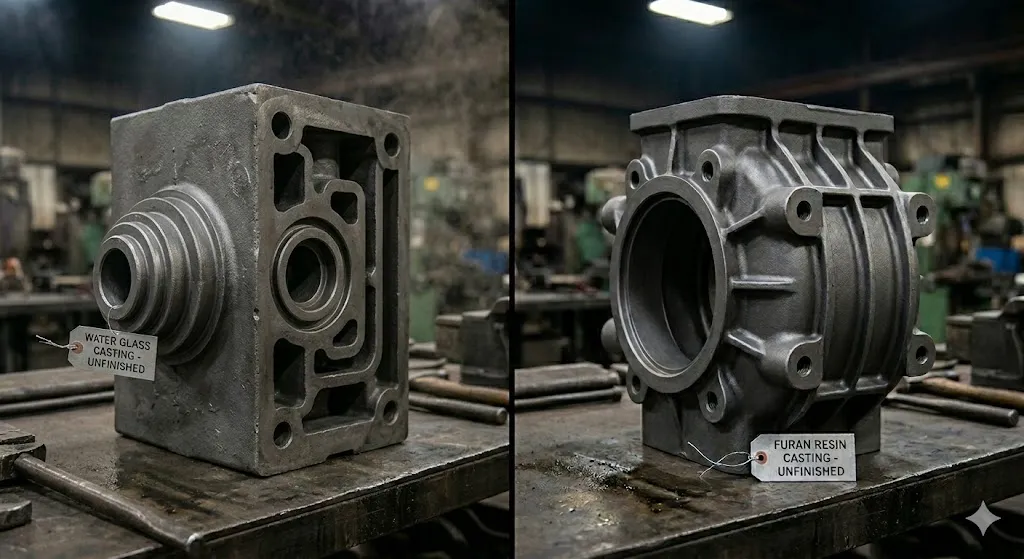
Water glass has been around forever. It’s still the go-to for heavy carbon steel castings where you absolutely cannot risk sulfur contamination from resin binders.
The good part:
Molds are rock solid. When you pour 500kg of molten steel, the mold won’t move. That matters for heavy railway castings.
The bad part:
It doesn’t collapse well after casting. The sand sticks like concrete. Your fettling crew will hate you. And if your part has thin sections or complex geometry, the restricted shrinkage can literally tear the casting apart while it cools – hot tearing is real.
The environmental bit everyone forgets:
Ja, water glass smells less during pouring. But you can’t recycle most of the sand. 70–80% ends up as waste. In Europe or the UK, that landfill tax adds up quickly.
When to actually use it
Big, chunky, geometrically simple parts – think center plates, simple brackets. You’re fine with a 10–12mm machining allowance. You don’t care that much about sand waste. And your main goal is low cost per kilo.
Furan resin no-bake is what people pick when they want tight tolerances (CT8–CT10) and a good surface finish. Parts come out closer to final shape – 4–7mm machining allowance instead of 10–12mm. That’s real money saved on CNC time.
But here’s the catch nobody tells you in the brochure:
When that resin hits hot metal, it off-gasses. A lot. If your foundry hasn’t designed the venting properly or isn’t using additives like iron oxide, you’ll get subsurface blowholes. They don’t show on the surface. They show on UT. And then you scrap the part after 20 hours of machining.
Also – sulfur. The hardeners in furan systems contain sulfur. For some steel grades, that gives you surface defects. For gray iron or ductile iron, it’s usually fine.
The upside on sustainability is real though. You can reclaim over 90% of the sand. That’s a big deal if you’re in a market with strict waste rules.
When to actually use it
Complex shapes, thin walls, or parts going into high-speed rail where fatigue matters. Also if your machining line uses expensive CNC machines and you want to save tool life. Just make sure the foundry has a track record of controlling gas defects – don’t assume they know how.
Heavy freight bogie (AAR M-201)
Simple shape. Low-alloy steel. Cost-driven. They used water glass. The 12mm machining allowance was accepted because the initial price beat everyone else. No big surprises.
European axle box (38588-St)
Complex with ribs. Needs UT and MPI. Furan resin. Saved 30% on machining time. But the first batch had blowholes until the foundry added better coatings and changed venting. Lesson: the process alone doesn’t guarantee quality – execution does.
Let’s stop asking “which process is better.” we may start asking these three questions:
If your part is big, simple, and made of carbon steel – water glass is fine.
If your part is complex, needs tight tolerances, or runs on automated CNC lines – spend the extra on furan resin. But inspect the first articles like your job depends on it, because gas porosity hides well until it doesn’t.
One last thing: talk to the foundrybefore you finish your drawings. A small change in wall thickness or rib design can make either process work a lot better. Good engineers do that. Bad ones just send out RFQs and complain later.
So here we want to say that we do this every day at Luoyang Fonyo Heavy Industries Co., Ltd. If you want to run a drawing past someone who’s actually poured both processes, send it over. No sales pitch. Just an honest answer on whether water glass or furan resin makes sense for your railway part.