Отсканируйте код WeChat, чтобы связаться с нами.
Отсканируйте код WeChat, чтобы связаться с нами.
Не стесняйтесь, отправьте нам электронное письмо, и мы ответим вам как можно скорее.
Создаем будущее сердцем и душой


On railway lines, the rails must be firmly fixed to the sleepers or track slabs. The component that accomplishes this crucial task is called the fastening system, and the railway spring fastener is the core of the entire fastening system. This part plays an irreplaceable role in the safety and smooth operation of railways.
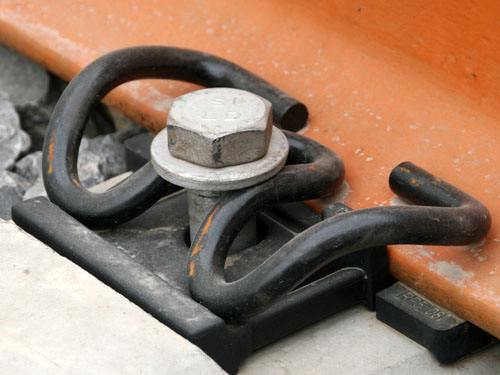
The unique value of the railway spring fastener stems from a series of characteristics conferred by its material and design.
1.1 High Elasticity
This is the most fundamental characteristic of the railway spring fastener. It is made of high-quality spring steel and undergoes special heating, forming, and heat treatment processes to achieve an extremely high elastic limit. When it is forcibly bent and inserted into the designated position by an installation tool, it undergoes significant elastic deformation. The restoring force generated by this deformation is the key to its continuous compression of other components.
1.2 Simple Structure and Easy Installation
A standard railway spring fastener is typically a single-piece component. During on-site installation, it is bent using a dedicated tool and then snapped into the corresponding shoulder or fastener base. This process is very quick and does not require complex tightening and torque control, significantly improving the efficiency of line construction and maintenance.
2.1 Durable Anti-loosening Performance
Unlike nuts and bolts that rely on threaded tightening, the spring fastener uses its own bending elasticity to provide compressive force. This force is a continuous static force that does not depend on the self-locking of threads. Поэтому, in a long-term and repetitive vibration environment, it does not loosen and fail as easily as ordinary threaded connections.
2.2 Stable Resistance
A well-designed and manufactured railway spring fastener provides a stable and predictable clamping force. Within its elastic range, even if the rails slightly expand or contract due to temperature changes, or if the pads wear slightly, the clamping force of the spring fastener will not significantly decrease, always keeping the rails firmly “held” in their designated positions.
3. Reliable Fatigue Life
Components on railway lines need to withstand millions of cycles of loading. The railway spring fastener is designed with high-cycle fatigue performance in mind. High-quality spring steel material and precise heat treatment processes ensure that it can resist metal fatigue during long-term and repetitive deformation, maintaining its performance without degradation, thus having a long service life.
Based on the above characteristics, the railway spring fastener achieves the following crucial functions in the railway system.
3.1 Fixing the Position of Rails
This is the most direct function of the railway spring fastener. It firmly presses the bottom of the rails against the under-rail pads or the rail-bearing surfaces of the sleepers through a strong clamping force. This effectively prevents the rails from moving unexpectedly in the vertical and horizontal directions. So it can ensure the precise and stable distance between the two rails (gauge). An accurate gauge is the foundation for the safe and smooth operation of trains.
3.2 Buffering and Vibration Damping
When train wheels roll over the rails, they generate intense vibrations and impact loads. The high elasticity of the railway spring fastener plays a buffering role here. It absorbs and distributes the energy, reducing the dynamic loads transmitted from the rails to the sleepers and even the ballast. This not only protects the sleepers and subgrade structures but also reduces the noise generated by train operation, enhancing ride comfort.
3.3 Ensuring Electrical Insulation
На электрифицированных железных дорогах и автоматических блок-участках, the track circuit is an important component of the signaling system. Поэтому, the fastening system needs to have good insulation performance. Although the railway spring fastener itself is a metal conductor, the insulating gauge blocks, rubber pads, and other components it is paired with form an insulation barrier. The correct compression of the fasteners ensures that these insulating components are properly installed and in close contact, thus guaranteeing the normal operation of the track circuit, which is the safety foundation for train signal control.
3.4 Resistance to Longitudinal and Lateral Forces
When a train is in operation, especially during acceleration, braking, and passing through curves, it exerts significant longitudinal (along the direction of the rail) and lateral (perpendicular to the rail) thrusts on the rails. The clamping force provided by the fasteners, combined with the resistance from the sleepers and ballast, forms sufficient resistance to counteract these forces and prevent the rails from creeping (longitudinal movement) or overturning (lateral tilting).
3.5 Facilitates Adjustment and Maintenance
Due to the relatively simple installation and removal of the fasteners, they can be quickly removed or reinstalled during track maintenance operations, such as replacing the pads, adjusting the gauge, or after tamping. This convenience greatly facilitates daily track maintenance and repair work.
The railway spring fastener is a key component that integrates high elasticity, anti-loosening, long service life, and easy installation. Its core function is to fix the rails, maintain the gauge, buffer vibrations, and ensure the insulation of the signal system. Regular inspection of the fasteners to check if they are correctly positioned and for any cracks or plastic deformation is an essential routine task in railway maintenance work.
Лоянская компания Fonyo Heavy Industries Co., ООО, основана в 1998 году, является производителем деталей для железнодорожного литья.. Наша фабрика занимает площадь 72 600 кв.м., с более чем 300 сотрудники, 32 техники, включая 5 старшие инженеры, 11 помощники инженера, и 16 техники. Наша производственная мощность составляет 30,000 тонн в год. В настоящее время, в основном мы производим литье, механическая обработка, и сборка для локомотива, вагон, высокоскоростные поезда, горное оборудование, энергия ветра, и т. д..
Мы поставляем железнодорожные детали для CRRC(в том числе более 20 филиалы и дочерние компании CRRC), Гемак инженерное оборудование, Санигрупп, Ситик Хэви Индастриз, и т. д.. Наша продукция экспортируется в Россию., Соединенные Штаты, Германия, Аргентина, Япония, Франция, ЮАР, Италия и другие страны мира.