Digitalize o código WeChat para entrar em contato conosco
Digitalize o código WeChat para entrar em contato conosco
Sinta-se à vontade para nos enviar um e-mail e responderemos o mais breve possível.
Criando o futuro com coração e alma


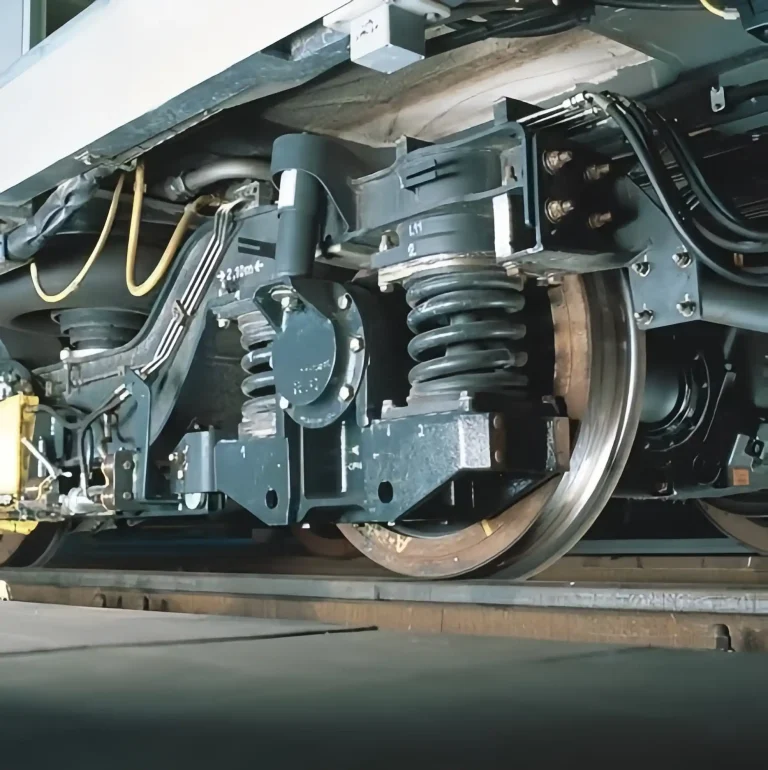
The locomotive wheel sets are pressed onto the axle. The distance between two wheels on the same axle is adapted to the track gauge, enabling the locomotive wheel sets to roll on the rail.
1.1 The part of the wheel that comes into contact with the rail, namely the outer ring of the wheel, is called the rim in the case of the wheel hub, and the rim or the rim ring is called the rim ring in the case of the wheel hub. The surface of the rim or rim ring that comes into contact with the rail is called the tread, and the protruding part on one side of the tread is called the flange. The flange is located on the inner side of the rail and can prevent the locomotive wheel sets from derailing and play a guiding role.
1.2 The part of the wheel that combines with the axle is called the hub. The hub is connected to the rim ring by spokes. The spokes can be continuous discs, called hub plates, or several cylindrical bodies arranged along the radius direction, called spokes.
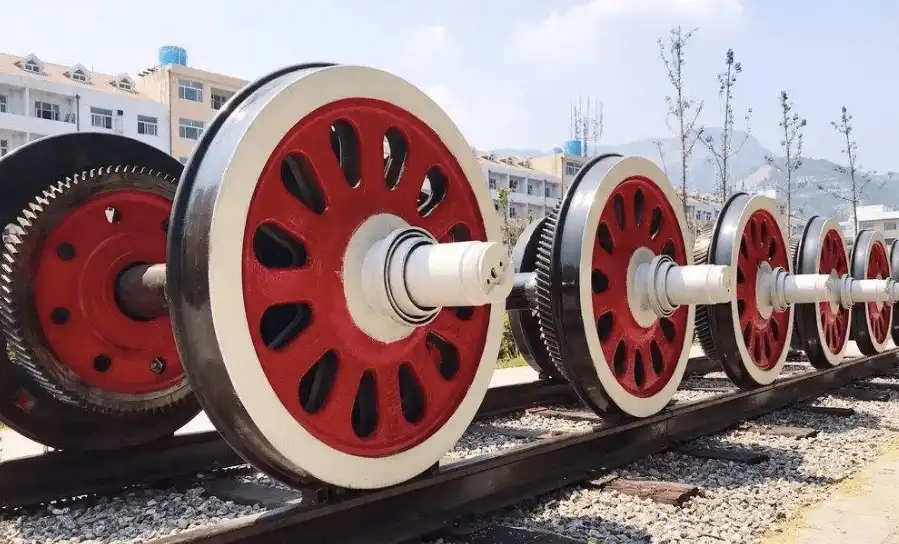
2.1 Rim wheels are formed by hot fitting the rim onto the hub and embedding the retaining ring. The retaining ring can prevent the rim from coming off when the fit between the rim and the hub is loose, and it serves as a safety stop.
2.2 Integral wheels are formed by combining the rim and the hub on the hub ring. Além disso, some countries also use wheels with elastic elements between the hub ring and the hub plate. Such wheels are called elastic wheels and are usually used only in underground railway vehicles.
3.1 The part of the wheel that comes into contact with the rail during operation bears a large pressure and generates elastic deformation and a large contact stress on the contact surface. Durante a operação, the two wheels inevitably roll on the rail with different diameters, resulting in skidding and wheel wear. Durante a frenagem, the tread of the wheel also undergoes severe wear by the brake shoe and generates high temperatures. All of these require that the material of the tread part of the wheel must have high strength, dureza, impact toughness, and good wear resistance.
3.2 The hub pressed onto the axle mainly bears elastic force, while the hub plates or spokes only bear pressure and bending force. These parts require higher toughness. The rim and hub of the rim wheel and the hub ring of the hub can be made of different materials, thus being able to better meet the above requirements. Integral wheels are inferior to rim wheels in tread wear resistance, but they are lighter in weight, cost less, e, mais importante, the rim does not loosen or crack. China’s railways still use rim wheels on locomotives, while passenger and freight vehicles have all been equipped with integral steel wheel sets.
The nominal value of the wheel diameter is the diameter at the point of the rolling circle (a plane parallel to the inner side of the wheel and 70 millimeters away from it intersects with the tread of the wheel). The wheel diameter used in Chinese railways is 840 millimeters for freight cars, 915 millimeters for passenger cars, 1050 millimeters for diesel locomotives, e 1250 millimeters for electric locomotives. The diameters of various rodas of steam locomotives vary depending on the model. The diameter of the driving wheel is usually between 1370 e 2000 milímetros.
5.1The contour line formed by the flange and the tread on the radial section of the wheel is selected. The choice of tread shape not only affects the wear and service life of the wheel but also directly relates to the curve passing performance and running quality of the locomotive and vehicle. The flange enables the wheel to pass through curves reliably and prevents derailment. The tread is conical, with a taper of 1:10 near the rolling circle.
5.2 When passing through a curve, the outer wheel rolls on the outer rail with a larger diameter close to the flange, and the inner wheel rolls on the inner rail with a smaller diameter. Por aqui, on the one hand, the locomotive wheel sets can guide the direction change of the line, e ao mesmo tempo, the different rolling distances of the inner and outer wheels can compensate for the influence of the difference in the lengths of the inner and outer rails.
5.3 When running on a straight line, if the locomotive wheel sets deviates from its center position on the line, the difference in the rolling radii of the two wheels will cause the locomotive wheel sets to move in the direction of restoring its center position. The outer side of the wheel has a taper of 1:5, which can increase the difference in the rolling radii of the two wheels and make it easier to pass through small-radius curves. No entanto, the conical tread is also the root cause of the locomotive and vehicle’s snake-like movement and the impact on running quality. Reducing the tread taper helps to suppress the snake-like movement, but the flange wear is significantly intensified, and the wheel rotation cycle and the service life of the wheel are greatly shortened. This method is only adopted in some high-speed passenger trains.
5.4 Por outro lado, the profile of the wheel flange and tread undergoes rapid wear in the initial stage of operation, then gradually stabilizes, and the wear slows down. The restored profile after re-profiling still cannot be maintained for a long time, and the amount of metal cutting is very large. Portanto, some countries’ railways have adopted a wheel tread profile that is close to the state where wear reaches a relatively stable level, which is called, also known as the wear-shaped tread. Adopting this profile not only reduces wheel wear, extends the re-profileding cycle but also improves the wheel-rail contact state, and the contact stress can also be reduced.
Luoyang Fonyo Indústrias Pesadas Co., Ltda,fundada em 1998, é fabricante de peças fundidas ferroviárias. Nossa fábrica cobre uma área de 72.600㎡, com mais de 300 funcionários, 32 técnicos, incluindo 5 engenheiros seniores, 11 engenheiros assistentes, e 16 técnicos.Nossa capacidade de produção é 30,000 toneladas por ano. Atualmente, produzimos principalmente fundição, usinagem, e montagem para locomotiva, vagão, trens de alta velocidade, equipamento de mineração,energia eólica,etc..
Somos o fornecedor de peças ferroviárias para CRRC(incluindo mais de 20 empresas filiais e subsidiárias da CRRC),Máquinas de Engenharia Gemac,Grupo Sany, Indústrias Pesadas Cíticas,etc.. Nossos produtos foram exportados para a Rússia, os Estados Unidos, Alemanha, Argentina, Japão, França, África do Sul,Itália e outros países em todo o mundo.