हमसे संपर्क करने के लिए WeChat कोड को स्कैन करें
हमसे संपर्क करने के लिए WeChat कोड को स्कैन करें
बेझिझक हमें एक ईमेल भेजें और हम यथाशीघ्र आपको उत्तर देंगे.
दिल और आत्मा से भविष्य का निर्माण करें


When people outside the railway industry look at an axle box, they usually see a simple steel housing attached to the wheelset. But for engineers working on freight bogies, the story is completely different. A railway axle box lives in one of the harshest environments on the train. Every vibration from the track, every braking force, every impact from uneven rail joints eventually passes through this component. If the axle box structure, सामग्री, or machining accuracy is not right, problems rarely stay small for long. That’s why, in actual railway manufacturing, engineers pay close attention to axle box design long before the component reaches final assembly.
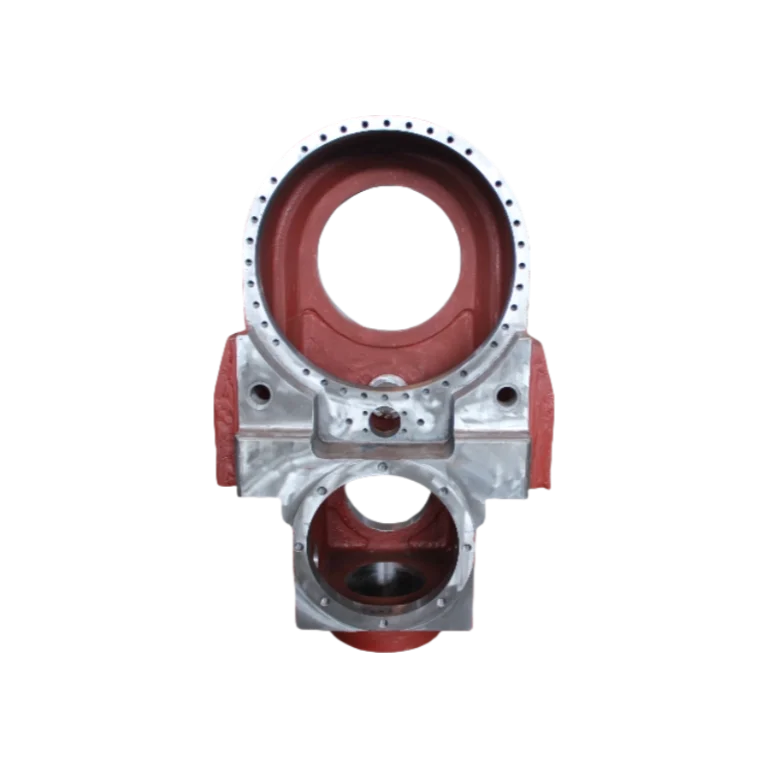
Inside the bogie system, the रेलवे एक्सल बॉक्स connects the rotating wheelset to the stationary bogie frame through the bearing assembly. Structurally, it sits between moving and load-bearing systems, which means it constantly experiences both force transmission and vibration.
In heavy freight applications, the axle box is expected to do several things at the same time:
What makes the component challenging is that these loads are never perfectly stable. Freight wagons experience track irregularities, lateral movement in curves, braking shock, and long-term vibration. अधिक समय तक, even small stress concentrations can become fatigue crack initiation points.
इंजीनियरिंग के दृष्टिकोण से, this is why axle box reliability is closely connected to casting quality and structural design.
A common misunderstanding is that railway components fail because they are “not strong enough.” In reality, many axle box problems are related to fatigue.
An axle box may survive a single heavy load without difficulty, but railway service is not about one load cycle. It is about millions of repeated cycles over many years.
This changes how engineers think about the design.
Sharp corners, uneven wall thickness, poor fillet transitions, and internal casting defects can all create localized stress concentration. सर्वप्रथम, nothing appears unusual. Then microscopic cracks begin to form. अंततः, those cracks propagate under cyclic loading.
That is why experienced railway manufacturers focus heavily on:
कई मामलों में, good fatigue performance starts at the mold design stage rather than the machining stage.
Material choice depends heavily on the service condition of the vehicle.
For lighter-duty applications, ductile iron may sometimes be used. But in heavy freight railway systems, cast steel is generally preferred because it offers better toughness and more stable fatigue performance under dynamic loading.
From the manufacturing side, material control is not only about chemical composition. Microstructure stability is equally important.
Two axle boxes can technically meet the same material grade on paper, yet behave very differently in service if:
This is one reason railway component manufacturing often involves much stricter process monitoring than general industrial casting.
In actual production, the most difficult part is usually not machining. The real challenge often begins much earlier during casting and process control.
उदाहरण के लिए, when engineers evaluate an axle box casting process, they are already thinking about:
Once the casting is completed, heat treatment becomes critical because residual stress inside large steel castings can later influence fatigue behavior in service.
गर्मी उपचार के बाद, machining accuracy directly affects bearing installation and alignment. Even small dimensional deviations may influence bearing load distribution during operation.
This is also why non-destructive testing is essential for railway safety components. In heavy railway castings, inspections such as UT and MT are not simply “final checks.” They are part of the manufacturing process itself.
When axle box problems occur in service, the root cause is often more complex than visible surface damage.
In many maintenance investigations, engineers trace failures back to combinations of factors such as:
सुहावना होते हुए, some failures begin from extremely small imperfections that were almost impossible to notice during early operation.
That is why railway component manufacturing places so much emphasis on process consistency rather than only final strength values.
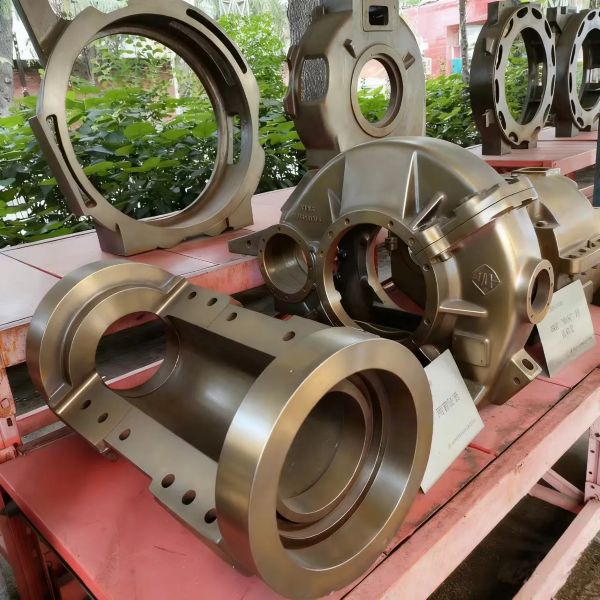
As a manufacturer of railway cast steel and forged components, we have worked with bogie-related parts that operate under continuous heavy-load conditions.
In these projects, manufacturing attention is usually focused on several key areas:
For heavy railway systems, component quality is rarely determined by one single process. It is the result of coordination between casting, उष्मा उपचार, मशीनिंग, और निरीक्षण.
From an engineering viewpoint, this is what ultimately determines whether a railway axle box can maintain long-term operational reliability in real freight service conditions.
The रेलवे एक्सल बॉक्स may not be the largest component in a bogie, but it is one of the most demanding from an engineering perspective.
It continuously operates under vibration, प्रभाव, cyclic stress, और कठोर पर्यावरणीय परिस्थितियाँ. इसके कारण, manufacturing a reliable axle box is never just about producing a casting with the correct dimensions. Long-term fatigue performance, internal quality stability, machining precision, and process consistency all play a critical role in real railway service conditions.
पर लुओयांग फ़ोन्यो हेवी इंडस्ट्रीज कंपनी, लिमिटेड, we manufacture railway axle boxes and other bogie components for heavy-duty railway applications, supported by in-house casting, उष्मा उपचार, मशीनिंग, और निरीक्षण क्षमताएँ.
To learn more about our railway manufacturing capabilities, मिलने जाना:
www.fonyorail.com