סרוק את קוד WeChat כדי ליצור איתנו קשר
סרוק את קוד WeChat כדי ליצור איתנו קשר
אתם מוזמנים לשלוח לנו מייל ואנו נענה לכם בהקדם האפשרי.
יצירת העתיד בלב ובנשמה


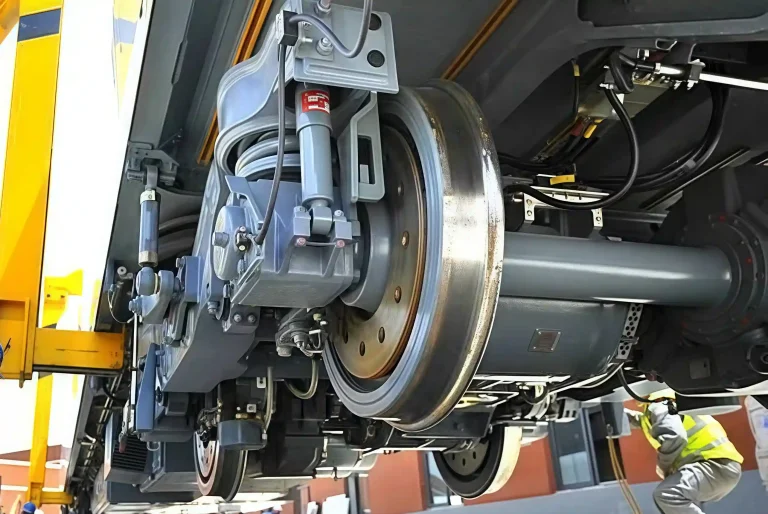
In freight wagon operation, מסגרות צד וחיזוקים are not just structural components on paper. לְמַעֲשֶׂה, they are constantly working under a combination of vertical load, lateral force, and impact from track irregularities.
What matters in real service is not the static strength value you see in a datasheet, but how the structure behaves after years of repeated loading.
From what we observe in production and failure analysis, most issues are not caused by “insufficient strength,” but by small inconsistencies that grow under fatigue over time.
That is why casting quality in these parts is always treated differently compared to general steel components.

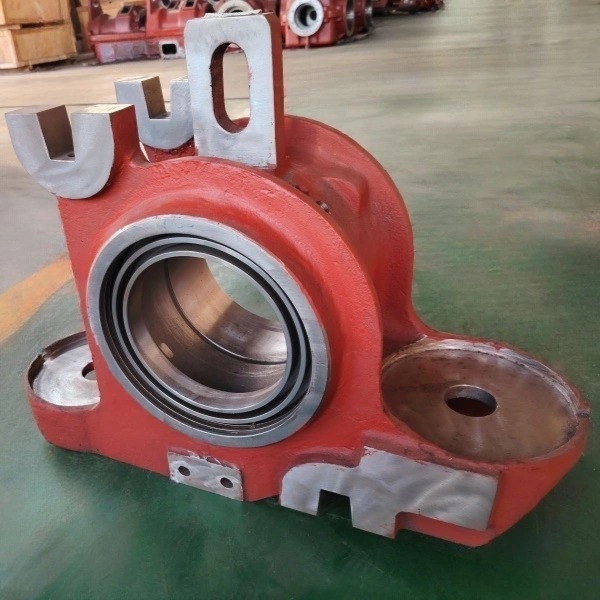
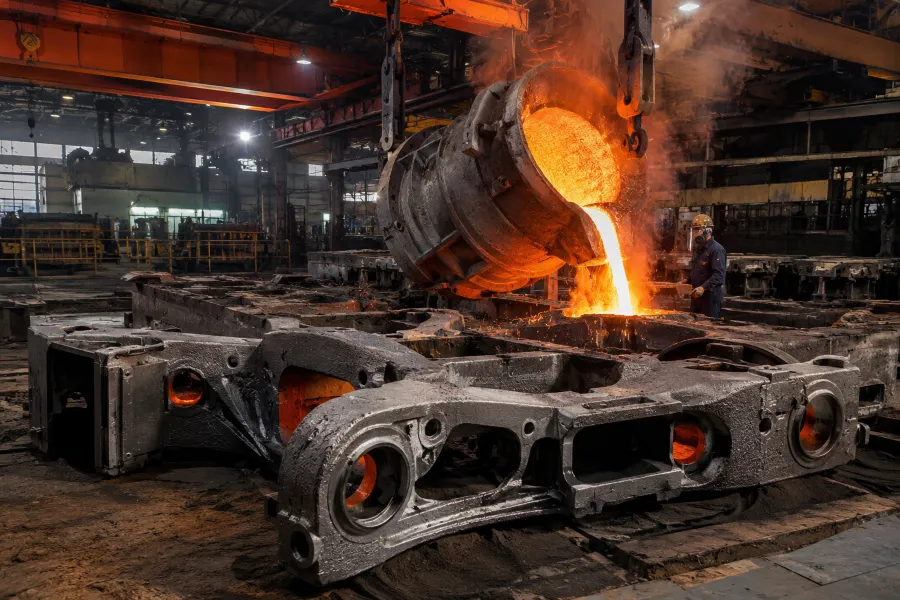
In real foundry practice, side frames and bolsters are produced using different sand casting routes depending on the plant’s capability and customer requirements.
Resin sand is widely used because it behaves predictably in large steel castings. Water glass systems are still common in cost-driven production, although they require tighter control to keep consistency stable.
Processes like V-method or lost foam are sometimes introduced for specific advantages, but in practice, engineers tend to evaluate them less by “theoretical benefits” and more by one simple question:
Can this process consistently control internal quality at production scale?
That is usually the real decision factor.
If you look at rejected castings in any railway foundry, a large portion of the issues can be traced back to molding and core assembly.
Traditional assembled cores are still in use, and they work well in flexible production. אוּלָם, every interface between cores is also a potential mismatch point. It may not be obvious on the surface, but under cyclic loading, these small discontinuities can become stress concentration zones.
This is the reason many plants are gradually shifting toward integral core systems. Not because it is “more advanced,” but because it simply reduces variables in production.
In casting, reducing variables is often more important than improving theoretical performance.
In resin sand production, one of the biggest advantages is stability. Once the process window is well established, it tends to repeat well across batches, which is exactly what railway components require.
Water glass systems can also produce good results, but anyone who has worked on them knows that performance is very sensitive to sand condition and process discipline. Small deviations in reclamation or hardening control often show up later as surface or internal defects.
תהליך V is interesting because of its clean surface and low machining allowance. But in real production environments, maintaining stable vacuum conditions during pouring is not always as simple as it looks in process diagrams.
Lost foam, although technically attractive for near-net-shape forming, is rarely used for primary load-bearing railway castings. The main concern is not geometry, but material integrity. The decomposition of foam introduces carbon-related effects that are difficult to fully eliminate, and that directly affects fatigue performance.
כך בפועל, most railway-grade foundries still rely on conventional sand-based systems.
When we talk about standards like AAR or EN, it is easy to think of them as simple “specifications to meet.” In reality, they are more like different engineering philosophies.
AAR requirements, especially M-201 and M-211, are very focused on consistency and traceability. The emphasis is not just on strength, but on how stable the material behaves across heat, פְּגִיעָה, and fatigue conditions.
In European projects, EN-based requirements are usually combined with customer-specific technical conditions. So instead of a single unified railway casting standard, what you often see is a layered specification system.
From a production perspective, the challenge is not choosing the grade, but ensuring that chemical composition, תכונות מכניות, and process stability all align at the same time.
Materials like ZG25MnNi or ZG25MnCrNi are widely used in China because they provide a good balance between strength and toughness. In terms of performance behavior, they are generally aligned with AAR Grade B-type requirements, although the actual equivalence always depends on test results rather than nominal composition.
In many failure investigations, heat treatment is the point where final performance is effectively determined.
The standard approach for bogie castings is normalizing, sometimes followed by tempering depending on required toughness levels.
In theory, quenching and tempering could increase strength further. But in real production of large railway castings, the risk profile changes significantly. Distortion, cracking tendency, and residual stress become much harder to control.
That is why most production lines prefer a more stable heat treatment route rather than pushing maximum mechanical values.
לְמַעֲשֶׂה, what matters is not peak strength, but whether the entire casting responds uniformly to thermal treatment.
When engineers analyze defects in side frames and bolsters, they rarely look at them as isolated issues.
A shrinkage cavity, לְדוּגמָה, is usually not just a “feeding problem.” It often reflects how solidification progressed in that region. באופן דומה, sand inclusion is rarely just a mold defect—it often points to instability somewhere earlier in the molding process.
Thermal cracks are even more complex. They are usually not caused by a single parameter, but by a combination of cooling gradient, geometry constraint, and local stress accumulation.
This is why experienced foundry engineers tend to focus less on “what defect appeared” and more on “why this location became vulnerable in the first place.”
That shift in thinking is what separates inspection-driven production from process-controlled production.
In railway casting, inspection is often misunderstood as the final quality step. במציאות, it is more of a confirmation stage.
UT, MT, and RT are used to verify internal and surface integrity, but they cannot compensate for process instability. If earlier stages are not well controlled, inspection will only reveal the problem, not solve it.
Dimensional inspection is equally important, especially for bogie assembly. Even small deviations can accumulate into alignment issues in final vehicle assembly.
So from an engineering standpoint, inspection is best seen as a feedback mechanism rather than a control method.
If we step back and look at the entire process, it becomes clear that railway bogie casting quality is not defined by a single decision—material, תַהֲלִיך, or heat treatment alone.
It is defined by how well the entire system is controlled as a whole.
בְּ Luoyang Fonyo Heavy Industries Co., בע"מ., we pay attention to good castings for railway and industry. We produce not only side frame and bolsters; we also produce railway wheels and other railway and industry components, אנא בקר באתר האינטרנט שלנו www.railwaypart.com כדי לקבל מידע נוסף עלינו. אם אתה מעוניין באחד מהמוצרים שלנו, אנא פנה אלינו, צוות ההנדסה שלנו יהיה כאן כדי לעזור לך.