Scannez le code WeChat pour nous contacter
Scannez le code WeChat pour nous contacter
N'hésitez pas à nous envoyer un email et nous vous répondrons dans les plus brefs délais.
Créer l'avenir avec cœur et âme


Les roues des locomotives sont l'un des composants les plus importants des systèmes ferroviaires. Contrairement aux roues des wagons de marchandises, qui supportent principalement des charges statiques et roulantes, les roues des locomotives travaillent dans un environnement beaucoup plus difficile. Traction force, chaleur de freinage, and cyclic fatigue all act on them at the same time.
In modern railways, especially for heavy-haul and high-power locomotives, the wheel isn’t just a passive rolling part. It’s an active part of the traction system, directly responsible for sending torque from the locomotive to the rail. That’s why its performance is key to both efficiency and safety.
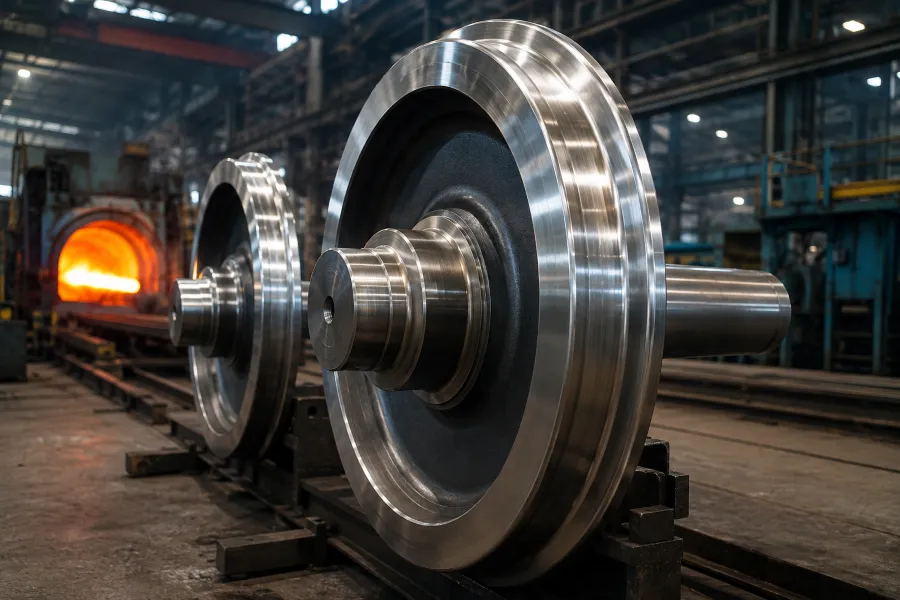
The working conditions for locomotive wheels are very different from those of standard railway wheels. Every time you accelerate, high tangential forces appear at the wheel-rail contact point. En même temps, braking puts a lot of heat into the wheel rim, especially on long freight runs or mountain routes.
Au fil du temps, these repeated mechanical and thermal loads create complicated stress patterns inside the wheel material. Problems like thermal fatigue, surface micro-cracking, and rolling contact fatigue don’t show up right away. They build up slowly over the wheel’s service life.
From an engineering standpoint, this means locomotive wheels need a stable balance between traction, thermal resistance, and long-term fatigue strength. If any of these is weak, the wheel’s service life will drop, or you’ll have to do maintenance more often.
One of the most important jobs of a locomotive wheel is transferring traction. The wheel has to keep enough grip on the rail to turn motor torque into forward motion without too much slip.
This process is a lot more complicated than it looks. At the contact patch between wheel and rail, the pressure is very concentrated, and the surface condition keeps changing because of wear, humidité, and load changes. Under high torque, any loss of grip can cause local slip, which then makes surface wear and heat even worse.
That’s why designing locomotive wheels means looking at more than just geometry. You also have to think about surface hardness stability and how the material responds to repeated stress cycles.
Another key factor in how well a locomotive wheel performs is the thermal stress from braking. Unlike freight wagons, locomotives go through many braking and acceleration cycles, especially during shunting or on routes with changing slopes.
When you brake, friction at the wheel-rail contact turns kinetic energy into heat, and the wheel rim absorbs that heat. If the material design and heat treatment don’t manage this heat well, you can get thermal fatigue cracks or local material damage.
In heavy-duty railway service, this heating and cooling cycle happens thousands of times over a wheel’s life. That makes thermal stability one of the most important performance measures.
To handle both traction stress and thermal loads, locomotive wheels are usually made with a deep, controlled rim hardening layer.
With carefully controlled heat treatment, the hardened layer on forged locomotive wheels can reach about 35–50 mm, depending on the wheel’s size and specs. This hardened zone is critical for resisting wear and slowing down crack formation during service.
A deeper, more stable hardening layer helps keep performance steady even after several reprofiling operations during maintenance. In real railway operations, that means longer time between maintenance and lower lifecycle costs.
But when it comes to locomotive wheel engineering, hardness alone isn’t enough. You also need to carefully control how hardness is distributed and how it transitions from hardened to non-hardened zones, so you don’t create internal stress concentrations.
Choosing the right steel grade for locomotive wheels isn’t just about strength. You need a careful balance of hardness, dureté, and resistance to crack growth.
Common materials include EN grades like ER8 and ER9, plus Class C and AAR-grade wheel steels for different railway systems. Parfois, custom alloy blends are used to meet specific needs like extreme temperature changes or very heavy axle loads.
The most important thing in material selection isn’t just the starting mechanical properties. It’s how the material performs under long-term cyclic loading and heat exposure.
How well a locomotive wheel performs depends a lot on how it’s made. From steel refining to final machining, every step affects the final microstructure and fatigue resistance.
The production process usually starts with controlled steelmaking and alloy adjustments, then hot forging to get a dense, uniform material structure. After shaping, the wheel rim goes through heat treatment to create the required hardness profile.
Then machining makes sure the dimensions are accurate, and non-destructive tests like ultrasonic and magnetic particle inspection find any internal or surface defects. Dynamic balancing is also done to keep things stable at high speeds.
Every one of these steps is essential, because even small changes in forging temperature or cooling rate can greatly affect the wheel’s fatigue life in real railway service.
Forged locomotive wheels are used in many railway applications, including heavy-haul freight locomotives, diesel-electric locomotives, electric mainline locomotives, and shunting locomotives.
They’re also used in high-power traction systems that need reliability and non-stop operation. In these settings, wheel performance directly affects safety, maintenance schedules, and overall efficiency.
Beyond outside dimensions and hardness numbers, the internal microstructure of a locomotive wheel is one of the biggest factors in how well it performs.
A stable, well-controlled microstructure improves resistance to cracks starting and growing, boosts fatigue strength, and ensures consistent behavior under thermal cycling. D'autre part, irregular grain structure or bad heat treatment can cause early failure in service.
That’s why microstructural control is seen as a core engineering parameter in making locomotive wheels, not just a secondary quality check.
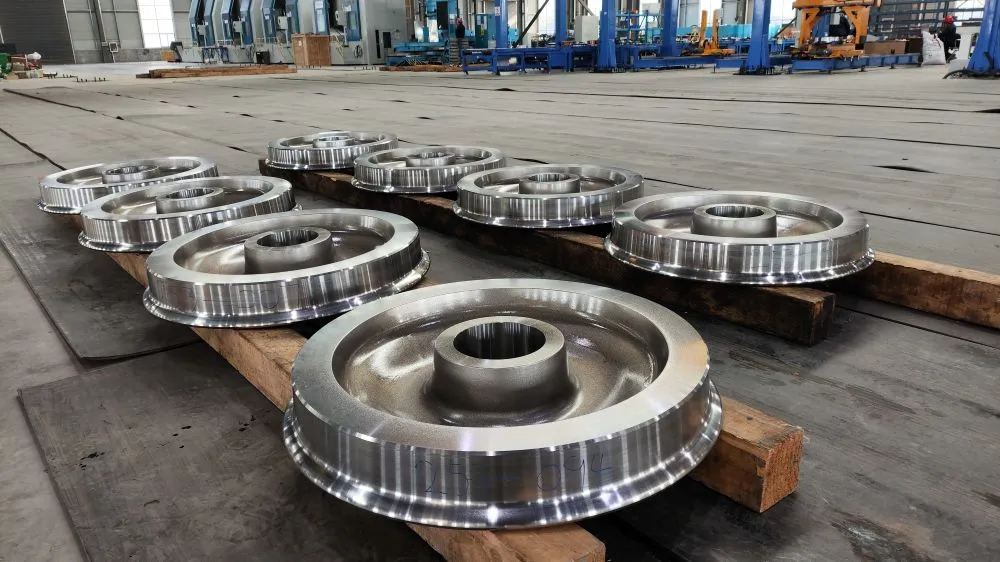
Nous Luoyang Fonyo Heavy Industries Co., Ltée. offer custom forged locomotive wheel manufacturing based on technical drawings and operating needs. That includes help with material selection, wheel profile optimization, heat treatment design, and full quality inspection documentation.
Each locomotive wheel is designed not just to meet size specs, but also to work reliably in real railway conditions over many service cycles.
For engineering advice, technical drawing reviews, or quote requests, our team gives direct support to make sure everything works with your specific locomotive systems and operating environments.