Escanea el código WeChat para contactarnos
Escanea el código WeChat para contactarnos
No dudes en enviarnos un correo electrónico y te responderemos lo antes posible.
Creando el futuro con corazón y alma


Las ruedas de locomotora son uno de los componentes más importantes de los sistemas ferroviarios.. A diferencia de las ruedas de los vagones de mercancías, que soportan principalmente cargas estáticas y rodantes, Las ruedas de las locomotoras trabajan en un entorno mucho más duro.. Traction force, calor de frenado, and cyclic fatigue all act on them at the same time.
En los ferrocarriles modernos, especially for heavy-haul and high-power locomotives, the wheel isn’t just a passive rolling part. It’s an active part of the traction system, directly responsible for sending torque from the locomotive to the rail. That’s why its performance is key to both efficiency and safety.
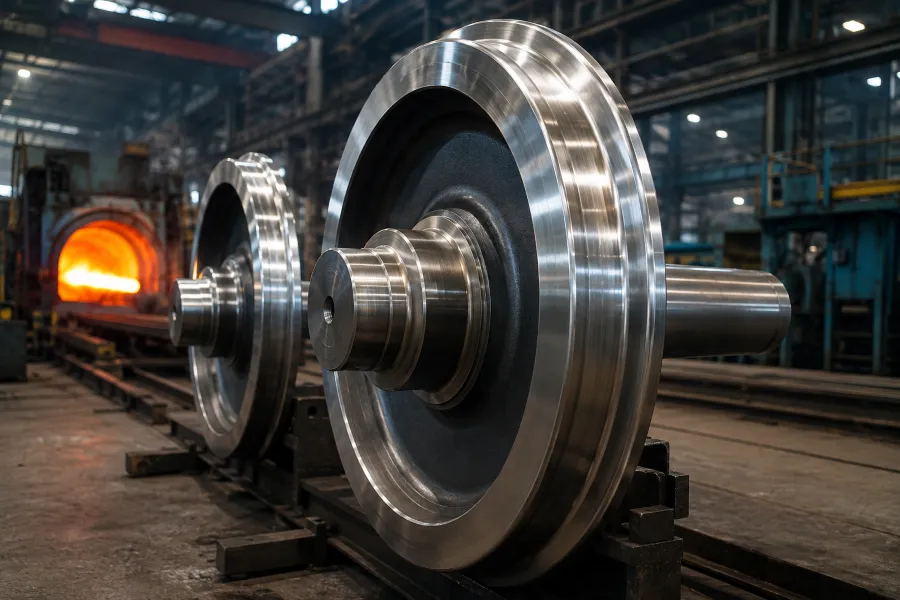
The working conditions for locomotive wheels are very different from those of standard railway wheels. Every time you accelerate, high tangential forces appear at the wheel-rail contact point. Al mismo tiempo, braking puts a lot of heat into the wheel rim, especialmente en trayectos largos de mercancías o rutas de montaña.
Con el tiempo, Estas cargas mecánicas y térmicas repetidas crean patrones de tensión complicados dentro del material de la rueda.. Problemas como la fatiga térmica., microfisuras superficiales, y la fatiga por contacto rodante no aparecen de inmediato. Se acumulan lentamente durante la vida útil de la rueda..
Desde el punto de vista de la ingeniería, Esto significa que las ruedas de las locomotoras necesitan un equilibrio estable entre tracción y, thermal resistance, y resistencia a la fatiga a largo plazo. Si alguno de estos es débil, la vida útil de la rueda disminuirá, o tendrás que hacer mantenimiento más seguido.
Una de las tareas más importantes de la rueda de una locomotora es la transferencia de tracción.. La rueda debe mantener suficiente agarre en el riel para convertir el par del motor en movimiento hacia adelante sin deslizarse demasiado..
Este proceso es mucho más complicado de lo que parece.. En la zona de contacto entre la rueda y el carril, la presión está muy concentrada, y la condición de la superficie sigue cambiando debido al desgaste., humedad, y cambios de carga. Bajo par alto, cualquier pérdida de agarre puede provocar un deslizamiento local, lo que empeora aún más el desgaste de la superficie y el calor.
Por eso, diseñar ruedas de locomotoras implica considerar algo más que la geometría.. También hay que pensar en la estabilidad de la dureza de la superficie y en cómo responde el material a ciclos de tensión repetidos..
Otro factor clave en el rendimiento de una rueda de locomotora es el estrés térmico causado por el frenado.. A diferencia de los vagones de mercancías, Las locomotoras pasan por muchos ciclos de frenado y aceleración., especialmente durante maniobras o en rutas con pendientes cambiantes.
cuando frenas, friction at the wheel-rail contact turns kinetic energy into heat, and the wheel rim absorbs that heat. If the material design and heat treatment don’t manage this heat well, you can get thermal fatigue cracks or local material damage.
In heavy-duty railway service, this heating and cooling cycle happens thousands of times over a wheel’s life. That makes thermal stability one of the most important performance measures.
To handle both traction stress and thermal loads, locomotive wheels are usually made with a deep, controlled rim hardening layer.
With carefully controlled heat treatment, the hardened layer on forged locomotive wheels can reach about 35–50 mm, depending on the wheel’s size and specs. This hardened zone is critical for resisting wear and slowing down crack formation during service.
A deeper, more stable hardening layer helps keep performance steady even after several reprofiling operations during maintenance. In real railway operations, that means longer time between maintenance and lower lifecycle costs.
But when it comes to locomotive wheel engineering, hardness alone isn’t enough. You also need to carefully control how hardness is distributed and how it transitions from hardened to non-hardened zones, so you don’t create internal stress concentrations.
Choosing the right steel grade for locomotive wheels isn’t just about strength. You need a careful balance of hardness, tenacidad, and resistance to crack growth.
Common materials include EN grades like ER8 and ER9, plus Class C and AAR-grade wheel steels for different railway systems. A veces, custom alloy blends are used to meet specific needs like extreme temperature changes or very heavy axle loads.
The most important thing in material selection isn’t just the starting mechanical properties. It’s how the material performs under long-term cyclic loading and heat exposure.
How well a locomotive wheel performs depends a lot on how it’s made. From steel refining to final machining, every step affects the final microstructure and fatigue resistance.
The production process usually starts with controlled steelmaking and alloy adjustments, then hot forging to get a dense, uniform material structure. After shaping, the wheel rim goes through heat treatment to create the required hardness profile.
Then machining makes sure the dimensions are accurate, and non-destructive tests like ultrasonic and magnetic particle inspection find any internal or surface defects. Dynamic balancing is also done to keep things stable at high speeds.
Every one of these steps is essential, because even small changes in forging temperature or cooling rate can greatly affect the wheel’s fatigue life in real railway service.
Forged locomotive wheels are used in many railway applications, including heavy-haul freight locomotives, locomotoras diesel-eléctricas, electric mainline locomotives, and shunting locomotives.
They’re also used in high-power traction systems that need reliability and non-stop operation. In these settings, wheel performance directly affects safety, maintenance schedules, and overall efficiency.
Beyond outside dimensions and hardness numbers, the internal microstructure of a locomotive wheel is one of the biggest factors in how well it performs.
A stable, well-controlled microstructure improves resistance to cracks starting and growing, boosts fatigue strength, and ensures consistent behavior under thermal cycling. Por otro lado, irregular grain structure or bad heat treatment can cause early failure in service.
That’s why microstructural control is seen as a core engineering parameter in making locomotive wheels, not just a secondary quality check.
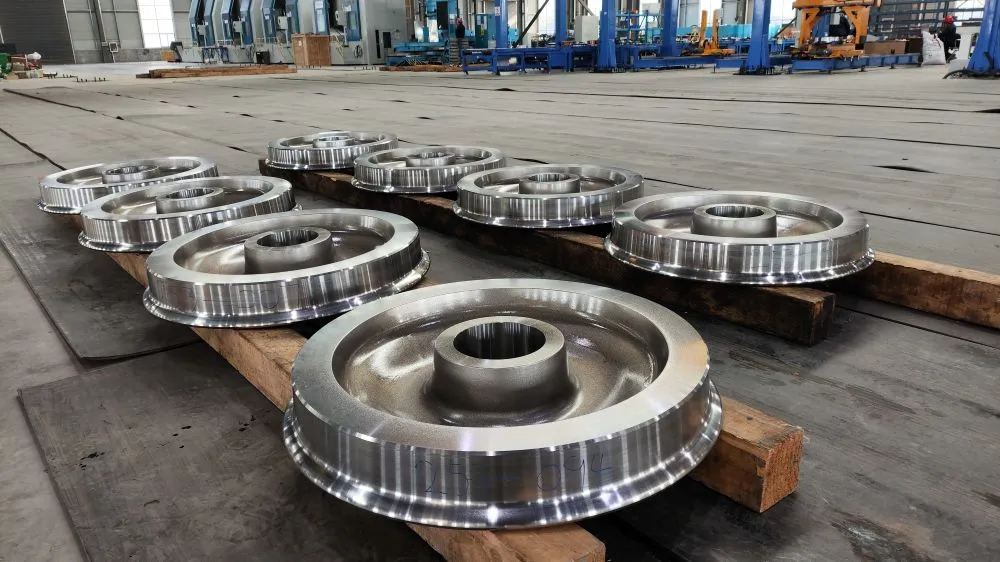
Nosotros Industrias pesadas Co. de Luoyang Fonyo., Limitado. offer custom forged locomotive wheel manufacturing based on technical drawings and operating needs. That includes help with material selection, wheel profile optimization, heat treatment design, and full quality inspection documentation.
Each locomotive wheel is designed not just to meet size specs, but also to work reliably in real railway conditions over many service cycles.
For engineering advice, technical drawing reviews, or quote requests, our team gives direct support to make sure everything works with your specific locomotive systems and operating environments.