Escanea el código WeChat para contactarnos
Escanea el código WeChat para contactarnos
No dudes en enviarnos un correo electrónico y te responderemos lo antes posible.
Creando el futuro con corazón y alma


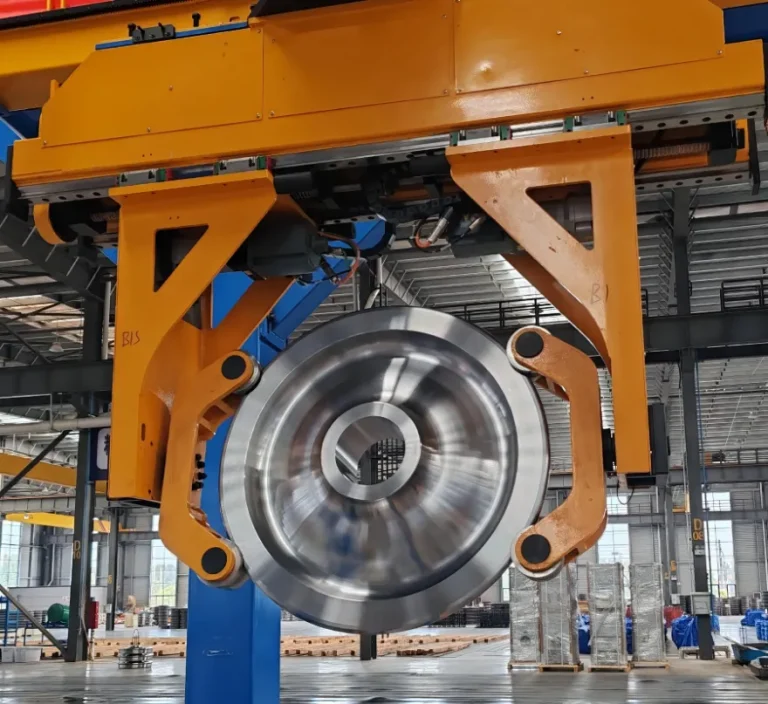
As we know, ruedas de ferrocarril are round and heavy; they are pieces of steel assembled on an axle, but do you know they are more than that? Every day, they face lots of challenges. They carry enormous loads, rodar a altas velocidades, and face constant friction from braking and curves. To face these extreme conditions, heat treatment is very necessary, which gives them good properties such as a right balance of hardness, fortaleza, y dureza. Without heat treatment, even the strongest steel would wear too quickly or crack under stress.
The first reason railway wheels need heat treatment is that they operate in a harsh environment. As we know, a train rolling at hundreds of kilometres per hour, carrying hundreds of tons of load, and passing through curves and switches. The wheels endure repeated rolling contact fatigue, calor de frenado, and sudden impacts. If the steel were left untreated after forging, it would be very likely to get rapid wear on the surface, brittle fractures in the interior, and uneven performance from wheel to wheel. So heat treatment can make the steel’s internal structure better, making the tread and flange hard and wear-resistant, while keeping the core of the wheel tough enough to absorb shocks safely.

There are several key heat treatment processes used for ruedas de ferrocarril, each with a specific purpose.
The first is normalizing, by this process, the steel is heated and then cooled in air to create a uniform crystal structure. This process helps remove internal stresses from forging and makes the metal grain more consistent. Essentially, normalising prepares the wheel for more specialized treatments later.
After normalizing, the next step is temple, in which the tread and flange are heated and cooled quickly, usually with water. Quenching makes these areas very hard and resistant to wear, which is very important because the tread and flange constantly contact the rail. Sin embargo, quenching alone makes the steel brittle, so it is not enough for the best properties of wheels.
To address this, the quenched areas of railway wheels undergo tempering. Tempering is a controlled heating process that reduces brittleness while maintaining most of the hardness gained from quenching. By tempering the tread and flange, engineers ensure that the surface of railway wheels is strong enough to resist wear, and is still tough enough to avoid cracking under heavy loads as well as repeated impacts. This combination of quenching and tempering creates a surface that can withstand millions of kilometres of rolling contact without failure.

Not all parts of railway wheels are treated in the same way. So now we have to mention the other important parts of wheels, they are the web, which connects the hub to the tread, y el centro itself is generally not quenched. These areas need to remain tough and flexible to absorb stress and support the wheel structure under heavy loads. If the web or hub were hardened like the tread, they would get brittle and would be very likely to crack. So with different treatment, the focus for these parts is on maintaining high toughness, which ensures that the wheel can handle shocks, vibración, and bending forces safely.
This differential heat treatment is what makes railway wheels so effective. So we know that by hardening only the tread and flange, the surface becomes wear-resistant, and they are able to resist daily rolling contact fatigue. Mientras tanto, the unquenched part of the web and hub is still tough and flexible, providing reliable support. This careful design ensures that railway wheels can perform consistently over many years, even under extreme operating conditions.
Here s where the magic of railway wheel design really shows. Not all parts of the wheel are treated the same.
| Part | Tratamiento térmico | Objetivo |
| Pisada | Local quenching + tempering | High hardness, wear-resistant, fatigue-resistant |
| Brida | Local quenching + tempering | Hard enough to resist wear, tough enough to prevent cracks |
| Web (spokes) | Usually no quenching | Maintain toughness and flexibility, absorber golpes |
| Centro | Usually no quenching | Strong core for load-bearing, stable under stress |
So we know that only the surface of the tread and flange needs to be hardened. While the inside of the wheel, including the web and hub, remains tough, not brittle. This is called differential or gradient treatment, and it is what allows wheels to last millions of kilometres safely.
En la práctica, the heat treatment of railway wheels requires precise control of temperature, cooling rates, and time. Engineers must carefully adjust the quenching and tempering processes to achieve the ideal balance between surface hardness and core toughness. By these prthat is safe, durable, y confiable, capable of carrying trains at high speeds and heavy loads without failure.
Al final, the heat treatment process is what transforms ordinary steel into specialized railway wheels that can satisfy the demanding requirements of the railway industry. It is not just about making the steel hard; it is about creating a wheel that has hardness where it is needed and toughness where it is critical. The tread and flange can undergo wear and contact stress, while the web and hub absorb shocks and provide stability. So these different treatments and combination process allows railway wheels to perform their critical role in train safety and reliability every day.
Understanding how railway wheels are heat-treated gives insight into the engineering behind every train journey. Each wheel is the result of careful design, precise heat treatment, and a deep understanding of how different parts respond to stress. From the hard, wear-resistant tread to the tough, flexible hub, every aspect is optimized to ensure safe and smooth operation.
En Industrias pesadas Co. de Luoyang Fonyo., Limitado. heat treatment is considered a critical step in railway wheel manufacturing. Both hardness and toughness are carefully balanced to help wheels withstand millions of kilometres of heavy loads, altas velocidades, and constant friction. By hardening the tread and flange while keeping the web and hub tough, engineers produce wheels that are durable, reliable, and safe. Every wheel reflects a combination of sound engineering principles and precise heat treatment, allowing trains around the world to run smoothly and reliably.
If you would like to learn more about our railway wheel products and manufacturing capabilities, por favor visita www.railwaypart.com for detailed information.
If you are interested in our products, please contáctanos.