Scan WeChat-koden for at kontakte os
Scan WeChat-koden for at kontakte os
Du er velkommen til at sende os en e-mail, og vi vil svare dig hurtigst muligt.
At skabe fremtiden med hjerte og sjæl


Place two railway rails side by side and, to most people, they look almost identical. Both are long steel sections with a rounded top, a narrow middle, and a wider base. Unless you work in the railway industry, it’s easy to assume that one railway rail is much the same as another.
Track engineers see something entirely different.
A slightly taller railway rail, a wider foot, or a few extra millimetres in the rail head immediately reveal clues about how that rail is expected to perform. Those dimensions aren’t random, nor are they chosen simply because one manufacturer prefers a different design. Every curve and every thickness reflects years of testing, operational experience, and continuous refinement.
That is one of the fascinating things about railway engineering. Components that appear simple often involve remarkably complex design decisions. A railway rail is a perfect example. Although its cross-section has changed gradually over the past century, every change has been driven by the same objective: carrying heavier loads, reducing maintenance, extending service life, and improving safety.
Understanding a rail profile is therefore about much more than learning a few dimensions from a drawing. It is about understanding why those dimensions exist in the first place.
I denne artikel, we’ll look beyond specification tables and examine railway rail profiles from an engineering perspective. Instead of simply comparing sizes, we’ll explore how different rail sections behave, why their geometry matters, and how engineers decide which profile is best suited for different railway applications.
One question often comes up when people first study railway rail.
If every rail supports trains, why are there so many different profiles?
The answer is surprisingly straightforward.
Different railways ask their rails to do different jobs.
Imagine three railway systems.
The first is a heavy-haul freight line carrying iron ore twenty-four hours a day. The trains are exceptionally heavy, axle loads are high, and maintenance windows are limited because traffic rarely stops.
The second is an urban metro. Trains are much lighter, stations are closely spaced, and passenger comfort is often just as important as structural strength.
The third is a high-speed railway where trains travel at more than 300 km/t. Her, smooth wheel guidance, stable vehicle dynamics, and precise track geometry become critical.
Although all three systems use steel rails, the demands placed on those rails are completely different.
This is why railway engineers rarely begin by asking, “Which rail profile is the strongest?”
I stedet, they ask a different question.
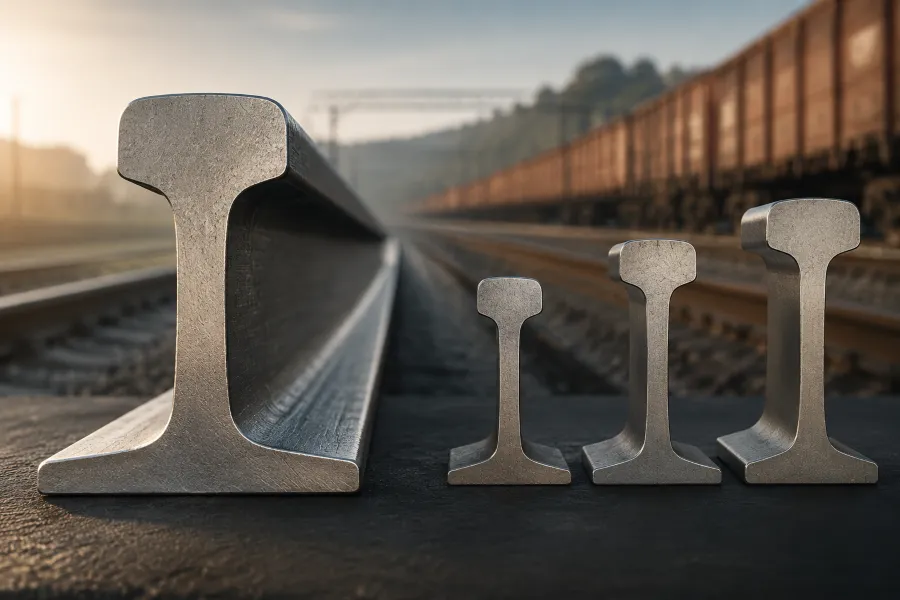
Only after answering that question does it make sense to select the rail section.
A rail profile is therefore not simply a shape defined by a drawing. It is a design solution developed for a particular combination of axle loads, operating speeds, traffic density, vedligeholdelsesstrategi, og levetid.
Open any railway standard and you’ll find a detailed cross-sectional drawing of a rail, complete with dimensions, tolerancer, and reference points.
To a manufacturer, those dimensions define how the rail should be rolled and inspected.
To an engineer, they tell a much more interesting story.
Every dimension influences the way forces travel through the rail.
Increase the overall height and the rail becomes more resistant to bending.
Change the width of the head and wheel–rail contact conditions begin to change.
Modify the foot and load distribution through the fastening system also changes.
One adjustment rarely affects only one aspect of performance.
I stedet, every dimension influences several others at the same time.
That is why rail design is often described as an exercise in balance rather than optimisation.
Engineers are rarely trying to create the biggest or strongest rail possible. They are trying to produce a rail that performs efficiently over decades of operation while remaining economical to manufacture, install, inspect, and maintain.
Once you begin looking at rail drawings this way, the dimensions stop being numbers on paper and start becoming engineering decisions.
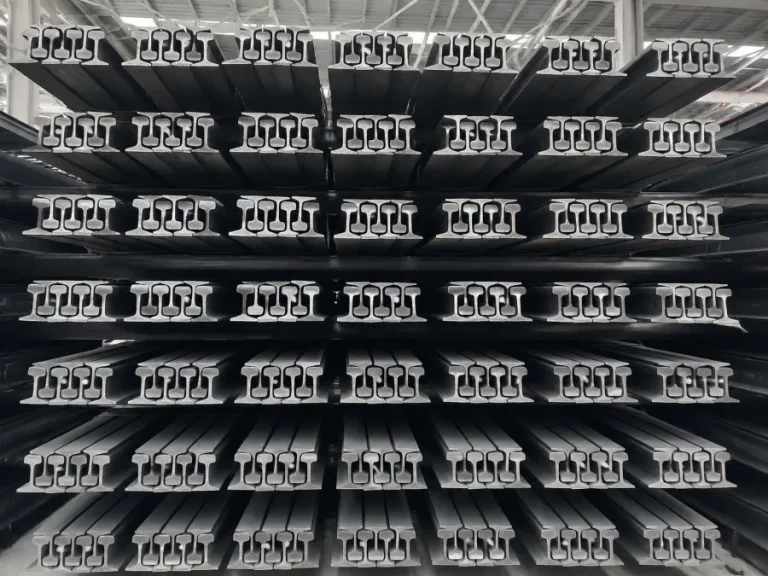
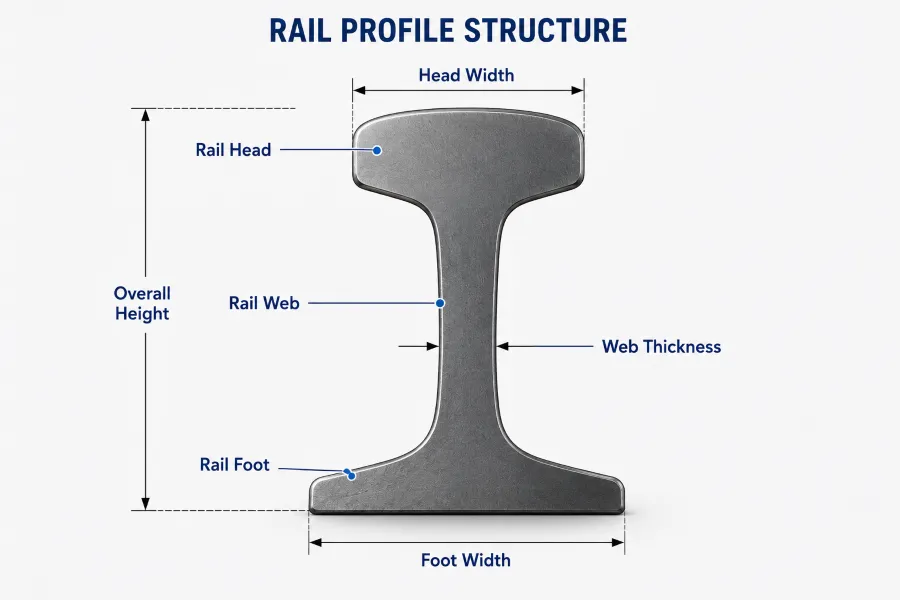
Every modern flat-bottom rail consists of three primary sections: the head, the web, and the foot.
Although they’re usually described separately, they should never be thought of as independent components. Together, they form a single structural system.
Let’s start at the top.
The rail head is where every wheel load enters the track. Surprisingly, the actual contact area between a steel wheel and a steel rail is often no larger than a coin. Yet that tiny contact patch carries enormous pressure every time a train passes.
På grund af dette, the rail head has to do far more than simply support weight. It must resist wear, maintain a predictable contact surface, minimise rolling contact fatigue, and continue guiding the wheelset accurately throughout years of service.
It’s tempting to think that making the rail head wider would automatically improve performance.
Unfortunately, railway engineering is rarely that simple.
A wider head provides more material for wear, but it also changes the geometry of wheel–rail contact. That can influence steering behaviour, contact stresses, and even vehicle stability on curves. Engineers therefore aim for the right head geometry rather than the largest possible one.
Moving downward, we reach the rail web.
Ved første øjekast, the web appears to do very little. It’s simply the narrow section connecting the head and the foot.
Structurally, imidlertid, it acts as the backbone of the rail.
As wheel loads travel through the rail, the web carries much of the resulting shear force while helping the rail resist bending between sleepers.
One obvious question follows.
Why not simply make the web thicker?
The answer reflects a principle found throughout engineering.
Every additional millimetre of steel increases weight, manufacturing cost, transportation cost, and rolling complexity. Beyond a certain point, adding more material produces only small improvements in performance.
Good engineering is not about using more steel.
It is about putting steel where it creates the greatest benefit.
Endelig, there is the rail foot.
If the head receives the load, the foot delivers that load into the sleepers and fastening system.
An easy way to understand its purpose is to imagine walking across soft ground.
High heels concentrate your weight into a very small area, causing the ground to sink beneath you.
A hiking boot spreads that same weight over a much larger surface.
The rail foot works in exactly the same way.
Its width helps distribute wheel loads more evenly into the supporting track structure, reducing local stresses and improving stability.
Once again, imidlertid, bigger is not automatically better.
A wider foot requires more material, influences fastening design, and affects the rolling process during manufacturing.
As with every other part of the rail, engineers are searching for balance rather than extremes.
When viewed together, the relationship becomes clear.
The head manages wheel contact.
The web transfers forces.
The foot distributes those forces safely into the track.
Change one without considering the others, and the behaviour of the entire rail changes.
That is why experienced railway engineers rarely discuss individual dimensions in isolation.
They evaluate the rail as one complete structural system.
When people compare two railway rail profiles, the first thing they usually notice is the height.
One rail may be slightly taller than another, and it’s natural to assume that the taller rail must also be stronger.
Sometimes that’s true.
Often, it isn’t the whole story.
Engineers are usually more interested in where the material is located than in how much material exists.
Moving steel farther from the centre of the section improves bending resistance much more effectively than simply increasing the overall mass.
Ligeledes, changing the shape of the rail head may influence wheel–rail contact far more than increasing the total weight by a few kilograms per metre.
This explains why two railway rail profiles with similar weights can perform quite differently in service.
Their dimensions may look similar on paper, but the way those dimensions work together determines how the rail behaves after millions of wheel passages.
After understanding how a rail works as a structural system, another question naturally follows.
Why do modern railways still use so many different rail profiles?
Wouldn’t it be simpler if every railway adopted exactly the same section?
Fra et produktionsperspektiv, perhaps it would.
Fra et ingeniørmæssigt perspektiv, the answer is much less straightforward.
Every railway operates under its own combination of traffic volume, akseltryk, driftshastighed, climate, maintenance philosophy, and construction budget. Those differences may seem small on paper, but over thirty or forty years of operation they have a significant impact on track performance.
A railway carrying a handful of passenger trains each day places very different demands on its rails than a freight corridor moving millions of tonnes of cargo every year. Ligeledes, a metro network with frequent acceleration and braking experiences loading conditions that are completely different from those of a high-speed railway.
This is why rail profiles have continued to evolve instead of converging into a single universal design.
The goal has never been to produce one railway rail that can do everything. The goal is to match the rail section to the work it will actually perform.
Among European rail profiles, UIC54 is often regarded as one of the best-balanced designs.
It provides sufficient bending strength for many conventional passenger lines and mixed-traffic routes without introducing unnecessary weight or material cost.
That balance is one of its greatest strengths.
Engineers sometimes describe UIC54 as an efficient profile because it delivers reliable performance across a wide range of operating conditions while remaining economical to manufacture and maintain.
People occasionally assume that UIC54 is simply an older version of UIC60.
I virkeligheden, they were developed for different operating requirements.
On railways where axle loads and traffic density remain within its design range, UIC54 can provide decades of dependable service. Replacing it with a heavier section would not automatically improve performance, but it would almost certainly increase construction costs.
As train frequencies increased and axle loads became heavier, many railway administrations needed a rail capable of carrying greater stresses with longer maintenance intervals.
UIC60 was developed to meet those demands.
Compared with lighter profiles, it offers greater bending stiffness and provides more material in areas that experience long-term wear. These characteristics make it particularly suitable for heavily trafficked main lines, high-speed railways, and freight corridors where maintenance opportunities are limited.
Its advantages, imidlertid, are often misunderstood.
The reason UIC60 performs well is not simply because it weighs more.
Its geometry has been carefully refined so that additional material is placed where it contributes most to structural performance and durability.
That distinction is important.
Adding steel everywhere would only increase weight. Good engineering is about using material efficiently, not generously.
Engineers who work internationally quickly notice that North American rail profiles differ from those commonly used in Europe and many parts of Asia.
This doesn’t mean one standard is technically superior.
It reflects different railway histories.
North American railways developed around long-distance freight transportation, often carrying extremely heavy axle loads across vast networks. European railways evolved under different priorities, balancing passenger services, freight traffic, and increasingly higher operating speeds.
As those networks developed, their engineering solutions naturally evolved in different directions.
Today’s AREMA and UIC rail profiles therefore represent different design philosophies shaped by decades of practical experience rather than fundamentally different engineering principles.
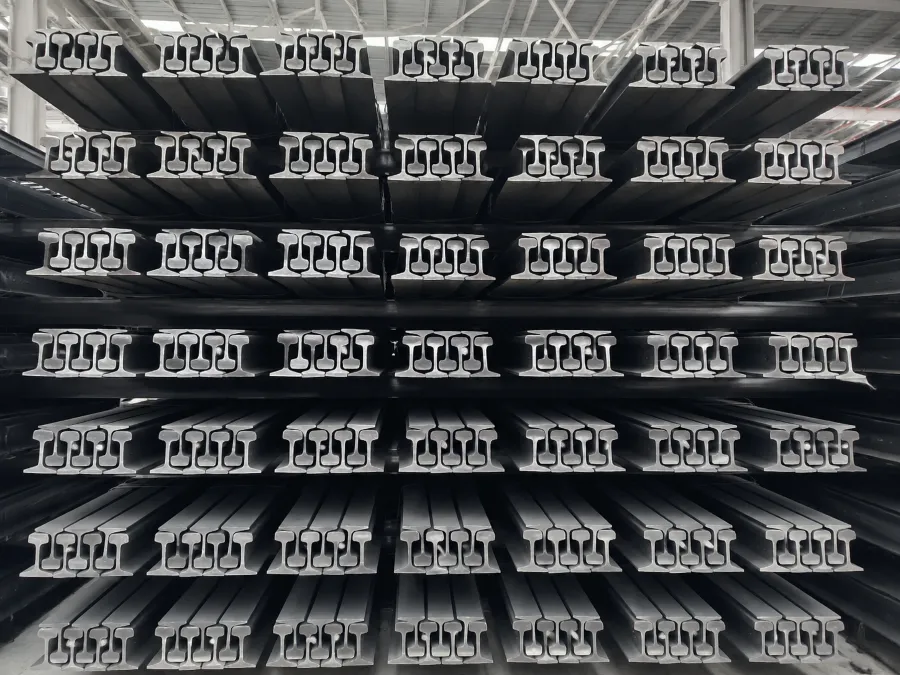
One of the most common questions in railway engineering sounds deceptively simple.
Which rail profile is the best?
Experienced engineers rarely answer that question directly because the question itself is incomplete.
Imagine you’re designing a brand-new railway.
Before discussing rail profiles, you would probably ask several other questions first.
How heavy are the trains?
How many trains will use the line each day?
Will they carry passengers or freight?
How large are the axle loads?
What is the expected service life?
How much maintenance can realistically be carried out each year?
Only after those questions have been answered does rail selection begin.
This approach explains why experienced engineers often spend more time understanding operating conditions than comparing catalogue specifications.
The rail profile is only one component within a much larger system.
Sleepers, fastening systems, ballast quality, wheel profiles, maintenance practices, and even local climate all influence how successfully a rail performs over its lifetime.
A profile that works exceptionally well on one railway may provide little advantage on another.
That is why railway engineering rarely deals in universal answers.
I stedet, it focuses on finding the most suitable solution for a particular set of conditions.
Outside the railway industry, rails are often described by their weight.
Terms such as 50 kg skinne, 60 kg skinne, eller 136 RE rail are widely used because they provide a quick way to identify different sections.
Weight is certainly important.
It influences transportation costs, installation methods, og, to some extent, structural capacity.
But experienced engineers know that weight alone tells only part of the story.
Imagine two beams made from exactly the same amount of steel.
One has been carefully designed to place more material where bending stresses are highest.
The other distributes its material less efficiently.
Although both weigh the same, their structural performance may be very different.
The same principle applies to railway rails.
The location of the material is often just as important as the amount of material itself.
This is why engineers pay close attention to properties such as section modulus and moment of inertia. These values describe how effectively the rail resists bending rather than simply how much steel it contains.
Med andre ord, a heavier rail is not automatically a better rail.
A well-designed profile usually outperforms a heavier but less efficient one.
Perhaps the biggest lesson hidden inside a railway rail profile is that engineering is rarely about maximising a single characteristic.
A taller rail improves bending resistance but increases material cost.
A wider head provides additional wear allowance but changes wheel–rail contact geometry.
A thicker web increases structural capacity but also increases weight.
A wider foot improves load distribution but influences fastening design and manufacturing.
Every improvement introduces a new trade-off.
That is why railway engineering has evolved through gradual refinement rather than dramatic redesign.
Modern rail profiles are the result of more than a century of operational experience. Countless engineers have tested, measured, modified, and improved these sections under real railway conditions.
What we see today is not the result of one brilliant design.
It is the result of thousands of practical engineering decisions accumulated over generations.
Ved første øjekast, a railway rail appears to be little more than a rolled steel section.
Look closer, imidlertid, and it becomes clear that every part of its geometry has a purpose.
The shape of the head influences wheel contact and wear. The web transfers forces through the rail while resisting bending. The foot distributes loads into the supporting track structure. Together, these elements determine how the rail performs over decades of service.
For that reason, engineers do not judge a rail profile by its appearance alone.
They consider how it behaves under load, how it interacts with wheels and fastening systems, how easily it can be maintained, and whether it is appropriate for the railway it is intended to serve.
Understanding railway rail profiles is therefore not about memorizing dimensions or comparing specification tables. It is about recognizing the engineering decisions behind those dimensions and how they contribute to the safety, pålidelighed, and long-term performance of modern railway infrastructure.
På Luoyang Fonyo Heavy Industries Co., Ltd., we apply the same engineering mindset to the products we manufacture. Vi er specialister i jernbanekomponenter, jernbanehjul, jernbanestøbninger, and custom-engineered railway parts for customers around the world. Whether you are sourcing standard railway products or developing components based on technical drawings, our engineering and manufacturing teams are committed to delivering reliable, high-quality solutions that meet international industry standards.
To learn more about our railway manufacturing capabilities and product range, visit www.railwaypart.com or contact our team to discuss your project requirements.