Scan WeChat-koden for at kontakte os
Scan WeChat-koden for at kontakte os
Du er velkommen til at sende os en e-mail, og vi vil svare dig hurtigst muligt.
At skabe fremtiden med hjerte og sjæl


Støbejern, et metalmateriale, der har fulgt menneskets industrielle civilisation i lang tid, stadig indtager en vigtig position i vores produktion og liv. Fra de robuste værktøjsmaskiner på fabrikker til de pålidelige motorblokke i biler, dens holdbarhed og omkostningsfordele har gjort den stedsegrøn. Imidlertid, støbejern er ikke statisk; det udvikler sig konstant i takt med teknologiens bølge, præsenterer flere klare udviklingstendenser.
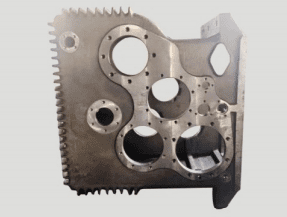
1.1 Almindelig gråt støbejern, som engang var meget brugt på grund af sin enkle støbeproces og lave omkostninger, er i stigende grad ude af stand til at opfylde de krævende ydeevnekrav for moderne udstyr på grund af dets iboende skørhed og begrænsede styrke. Som et resultat, materialer med overlegen ydeevne, såsom duktilt jern og austempereret duktilt jern, er efterhånden kommet i forgrunden.
1.2 Ductile iron achieves a transformation of the internal graphite from flake to smooth spherical form by adding trace amounts of magnesium or rare earth elements to the molten iron. This morphological change significantly eliminates the splitting effect of graphite sharp corners on the metal matrix, leading to a qualitative leap in tensile strength and elongation. Austempered ductile iron, on this basis, undergoes a special quenching heat treatment, further enhancing its hardness and wear resistance to a new level. I dag, these high-strength cast irons can be found in critical components such as the giant hubs of wind turbines and the rear axle housings of heavy trucks.

2.1 Especially in the automotive and aerospace industries, reducing the weight of components is directly related to energy efficiency and performance improvement. Traditional cast iron parts often give people the impression of being “omfangsrigt”, which has prompted the industry to shift its research and development direction towards thin-walled high-strength cast iron. Through precise casting control, it is now possible to stably produce cast iron parts with a wall thickness of less than three millimeters while still maintaining sufficient structural strength.
2.2 Desuden, the composite design of cast iron with lightweight materials such as aluminum alloys has also become a popular solution. F.eks, in engine components, cast iron is used for the critical parts that bear pressure and wear resistance, while other parts are made of aluminum alloys. Denne vej, both performance and weight reduction goals are achieved.
3.1 In chemical equipment, marine facilities, or engines that operate at high temperatures for long periods, materials must not only be strong but also resistant to corrosion and high temperatures.
Ordinary cast iron is prone to rust in damp or acidic and alkaline environments and may oxidize or undergo permanent deformation at sustained high temperatures. To address these issues, alloying is an effective approach. Increasing the content of elements such as silicon, krom, and nickel in cast iron can significantly enhance its protective capabilities. High-silicon cast iron can withstand the erosion of various strong acids, while high-chromium cast iron can remain stable for long periods in red-hot high-temperature environments. Although these special cast irons have a higher unit price, their long service life and extremely high reliability make them economically invaluable in specific applications.
3.2 The green and energy-saving transformation of the production process is also a core issue in the current cast iron industry.
Traditional casting production is a major consumer of energy and emitter of pollutants. Faced with global environmental pressure, foundries are actively seeking changes. More and more enterprises are using medium-frequency electric furnaces to replace some cupola furnaces that use coke as fuel. This transformation can significantly reduce the emissions of carbon dioxide and sulfides. In terms of waste treatment, avanceret gammel sandregenereringsteknologi gør det muligt at genbruge det meste af støbesand, kraftigt reducere mængden af fast affald, der sendes til lossepladser. Desuden, optimering af produktionsprocessen og tæt sammenkobling af smelte- og hældestadierne for at danne en “kort proces” støbning kan også effektivt reducere energiforbruget gennem hele processen. Disse foranstaltninger skal ikke kun opfylde stadig strengere miljøbestemmelser, men også direkte hjælpe virksomheder med at spare produktionsomkostninger.
3.3 Vi kan også konstatere, at støbejern hele tiden underopdeles i retning af funktionalisering og specialisering.
Det er ikke længere blot et generelt strukturelt materiale, men er udstyret med mere specifikke missioner. I situationer, hvor der kræves ekstrem høj slidstyrke, såsom hammerhovederne på mineknusere, wear-resistant cast iron containing high-hardness carbides is adopted. For the bases of precision machine tools, gray cast iron’s excellent vibration damping performance is valued, as it can effectively absorb vibrations and ensure processing accuracy. In automotive engines and braking systems, cast iron with specialized thermal conductivity requirements is used to manufacture pistons and brake discs. Denne “tailor-made” approach to material development enables cast iron to exert its maximum efficiency in the most suitable places.
Before the castings are produced, engineers can use computer simulation software to precisely preview the entire pouring and solidification process, thereby identifying and avoiding potential shrinkage cavities and porosity defects in advance. On the production line, automated inspection equipment such as ultrasonic non-destructive testing instruments and direct reading spectrometers provide real-time and strict monitoring of the composition of each batch of molten iron and the quality of each batch of products. These technologies ensure the high stability of the performance of cast iron products and lay a solid foundation for the research and development of more advanced new types of cast iron.
Today’s cast iron materials are steadily advancing along several main paths, including strengthening, letvægts, weather resistance, miljøvenlighed, functionalization, and intelligence. This evolutionary process not only reflects the progress of materials science itself but also directly embodies the increasingly higher and more precise demands of modern industry on basic materials. There is no doubt that through continuous self-innovation, this ancient metal, støbejern, will continue to play an indispensable role in the industrial landscape of the future.
Luoyang Fonyo Heavy Industries Co., Ltd,grundlagt i 1998, er en producent i jernbanestøbningsdele. Vores fabrik dækker et areal på 72.600㎡, med mere end 300 medarbejdere, 32 teknikere, inklusive 5 senioringeniører, 11 assistentingeniører, og 16 teknikere.Vores produktionskapacitet er 30,000 tons om året. For tiden, vi producerer hovedsageligt støbning, bearbejdning, og montage til lokomotiv, jernbanevogn, højhastighedstog, mineudstyr,vindkraft,osv.
Vi er leverandør af jernbanedele til CRRC(inklusive mere end 20 filialselskaber og datterselskaber af CRRC),Gemac Engineering Machinery,Sanygroup, Citic Heavy Industries,osv. Vores produkter er blevet eksporteret til Rusland, USA, Tyskland, Argentina, Japan, Frankrig, Sydafrika,Italien og andre lande over hele verden.