Digitalize o código WeChat para entrar em contato conosco
Digitalize o código WeChat para entrar em contato conosco
Sinta-se à vontade para nos enviar um e-mail e responderemos o mais breve possível.
Criando o futuro com coração e alma


Most people assume that railway wheels quality depends mainly on dureza.
Na realidade, experienced wheel manufacturers pay just as much attention to microstructure.
Duas rodas ferroviárias podem ter as mesmas dimensões, similar hardness values, and even meet the same specification. Yet one wheel may achieve a much longer service life than the other. The reason often lies inside the steel itself.
When metallurgists examine a roda ferroviária, one of the first things they look for is a predominantly pearlitic structure. If significant non-pearlitic regions are present, the wheel may wear faster, develop cracks earlier, or require more frequent maintenance.
This is why microstructure control remains one of the most important parts of railway wheel manufacturing.
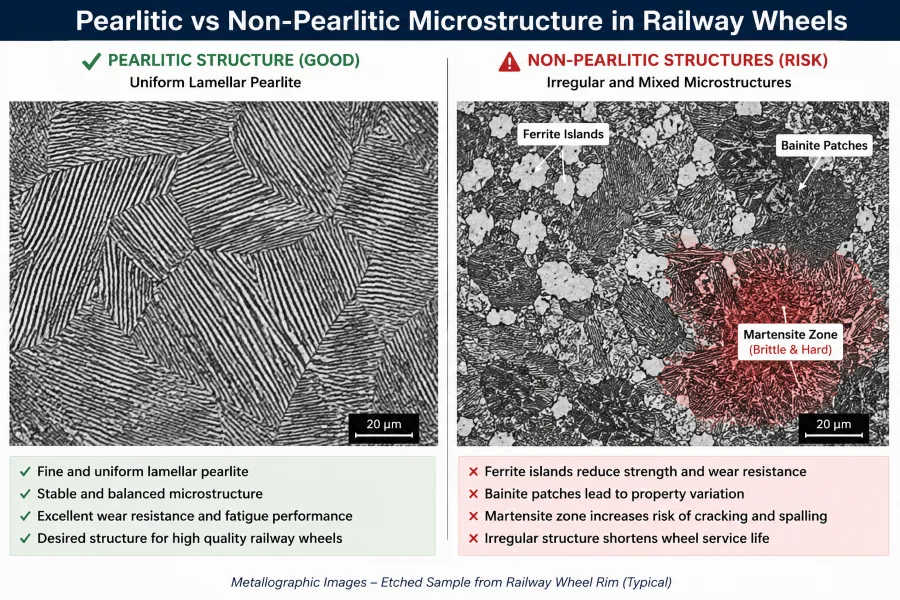
The term pearlitic railway wheels refers to wheels whose rim area consists primarily of pearlite, a microstructure formed by alternating layers of ferrite and cementite.
To someone outside the metallurgy field, that definition may not seem particularly important. No entanto, for railway engineers, pearlite has earned its reputation through decades of real-world service.
Railway wheels face a difficult challenge. They must resist wear under constant wheel-rail contact, but they also need enough toughness to withstand impact loads, traction forces, and repeated stress cycles. A wheel that is too soft wears quickly. A wheel that is too hard becomes more vulnerable to cracking.
Pearlite provides a balance between these two extremes. That balance is one reason why pearlitic railway wheels remain the dominant choice for freight wagons, passenger coaches, locomotivas, and metro vehicles around the world.
The railway industry did not choose pearlite by accident.
Over many decades, wheel manufacturers and railway operators have learned that pearlitic structures consistently deliver reliable performance under demanding service conditions.
One of the main advantages is wear resistance. The fine lamellar structure of pearlite helps the wheel tread resist material loss during continuous contact with the rail. This allows wheels to maintain their profile for longer periods and reduces the frequency of reprofiling.
Pearlite also performs well when subjected to rolling contact fatigue. Every wheel experiences millions of loading cycles during its service life. Ao longo do tempo, these repeated stresses can initiate cracks beneath the surface. A well-developed pearlitic structure helps delay this process and contributes to longer wheel life.
Perhaps most importantly, pearlite offers a practical balance between hardness and toughness. In railway applications, maximizing hardness alone is rarely the correct approach. Experienced engineers know that excessive hardness often creates new problems. A wheel must survive not only wear but also impact, vibração, and thermal stress.
That balance is exactly what makes pearlitic wheel steels so successful.
When metallurgists inspect a railway wheel under a microscope, they are not simply looking for pearlite. They are also looking for structures that should not be there.
A small amount of variation is normal. Steel is a complex material, and no manufacturing process is absolutely perfect. No entanto, when non-pearlitic structures occupy a significant portion of the wheel rim, wheel performance can change dramatically.
The most common examples include ferrite, bainite, martensite, and Widmanstätten structures.
Ferrite is naturally softer than pearlite.
À primeira vista, this may not sound like a serious problem. After all, softer materials are often less prone to cracking. No entanto, railway wheels operate in an environment where wear resistance is critical.
When excessive ferrite is present, the wheel tread tends to wear more rapidly under normal service conditions. Ao longo do tempo, this can increase maintenance frequency and shorten wheel life.
Engineers sometimes discover this problem when wheels begin losing material faster than expected, even though other manufacturing parameters appear acceptable. A metallographic examination often reveals that the pearlite content is lower than intended.
Bainite is an interesting microstructure because it is widely used in some high-strength steel applications.
No entanto, conventional railway wheel designs are generally optimized around pearlitic structures. When bainitic regions appear unexpectedly, they can create differences in hardness and mechanical behavior within the wheel.
These differences may not cause immediate failure. The concern is that localized variations in properties can lead to uneven stress distribution during service.
Over thousands of operating hours, those small differences can contribute to fatigue damage and accelerated deterioration.
Among all non-pearlitic structures, martensite usually causes the greatest concern.
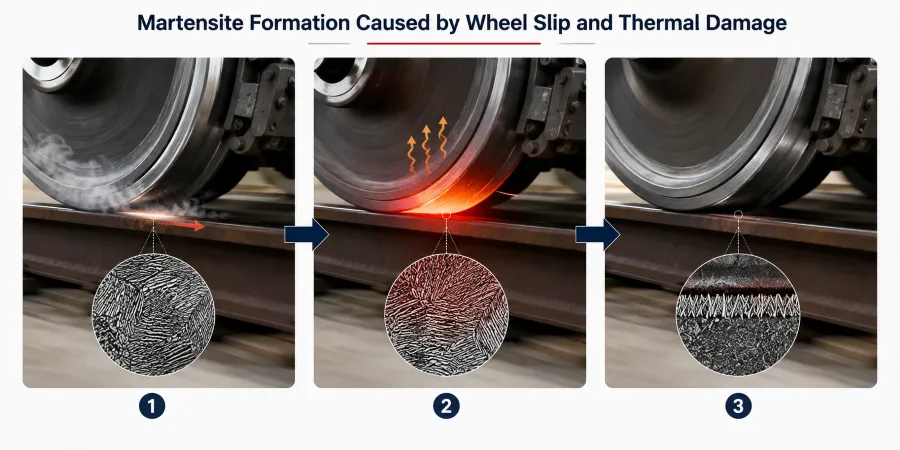
Em muitos casos, martensite is not created during manufacturing. Em vez de, it develops later because of severe thermal damage in service.
Heavy braking, wheel slides, or localized overheating can rapidly heat the wheel tread. When the affected area cools again, a martensitic layer may form near the surface.
The problem is that martensite is extremely hard but also brittle.
This combination can be dangerous. The wheel may appear stronger because hardness values increase, but the material becomes more susceptible to cracking. Surface cracks can then grow under repeated wheel-rail contact, eventually leading to shelling or spalling.
This is one reason why wheel burns receive so much attention during railway wheel inspections.
Widmanstätten structures are less common than ferrite or martensite, but they are still undesirable in railway wheels.
They usually develop when cooling conditions are not properly controlled during manufacturing.
From a practical perspective, the main concern is toughness. Wheels containing significant Widmanstätten structures often exhibit reduced resistance to crack propagation. Once a crack begins, it may grow more easily than it would in a fully pearlitic structure.
For components that operate under millions of cyclic loading events, this is not a characteristic engineers want to see.
The effects of non-pearlitic structures are not always immediately visible.
A newly manufactured wheel may pass dimensional inspections and even meet hardness requirements. Yet problems can still emerge months or years later during service.
This is why experienced railway engineers often say that the true quality of a wheel is revealed over time.
One of the most common consequences is accelerated wear. When softer structures such as excessive ferrite are present, the wheel tread loses material more quickly under normal wheel-rail contact. Inicialmente, the difference may appear small. No entanto, over hundreds of thousands of kilometers, wear rates can become significantly higher than expected.
Fatigue performance can also be affected.
Railway wheels experience repeated loading every time they roll over the rail. These stress cycles never completely disappear. Em vez de, they accumulate throughout the wheel’s service life.
When the microstructure is uniform, stresses tend to be distributed more evenly. When different structures exist within the same wheel rim, local stress concentrations can develop. These areas often become the starting points for fatigue cracks.
This is particularly important for heavy-haul railways, freight operations, and locomotive applications where wheel loads are especially demanding.
Another concern is surface damage.
Engineers frequently encounter defects such as shelling, fragmentação, and thermal cracking during wheel inspections. While these issues can have multiple causes, undesirable microstructures often make the situation worse. Once cracking begins, the wheel’s ability to resist further damage is reduced.
Em última análise, the result is shorter service life, more maintenance interventions, and higher operating costs.
Whenever a non-pearlitic structure is discovered, the next question is usually simple: how did it get there?
Na maioria dos casos, the answer can be traced back to either manufacturing conditions or service-related thermal damage.
Heat treatment is often the first area engineers investigate.
Producing high-quality pearlitic railway wheels requires careful control of heating temperatures, holding times, and cooling rates. If any of these parameters fall outside the desired range, the steel may not transform into the intended microstructure.
Cooling rate is particularly important.
Steel does not simply cool down; it transforms while cooling. Small changes in cooling conditions can produce very different microstructures. This is why wheel manufacturers invest heavily in process control and heat treatment technology.
Chemical composition also plays a role.
The balance of carbon, manganês, silício, and other alloying elements influences how steel behaves during heat treatment. Even a well-designed process can struggle to produce consistent results if chemical composition is not properly controlled.
Claro, not all microstructural problems originate during manufacturing.
Railway wheels are exposed to harsh service conditions. Severe braking events, wheel slides, and thermal overload can locally alter the microstructure long after the wheel leaves the factory. Em alguns casos, a wheel that originally contained an excellent pearlitic structure may later develop martensitic regions due to overheating.
This is one reason why periodic wheel inspection remains essential throughout the wheel’s service life.
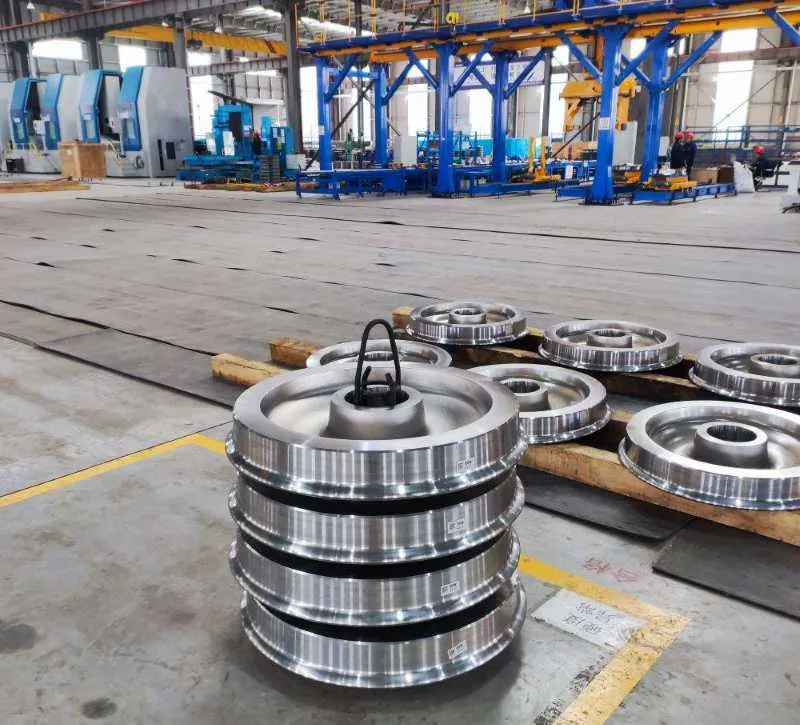
Para fabricantes de rodas, achieving a pearlitic structure is not a matter of luck. It is the result of controlling every step of the production process.
The process begins with steelmaking.
Raw materials, alloying elements, and refining procedures must be carefully managed to produce clean steel with consistent chemistry. Small variations at this stage can influence everything that follows.
Forging is equally important.
A properly executed forging process helps refine the grain structure and improve the internal quality of the wheel. It also creates a solid foundation for subsequent heat treatment.
The next critical stage is heat treatment.
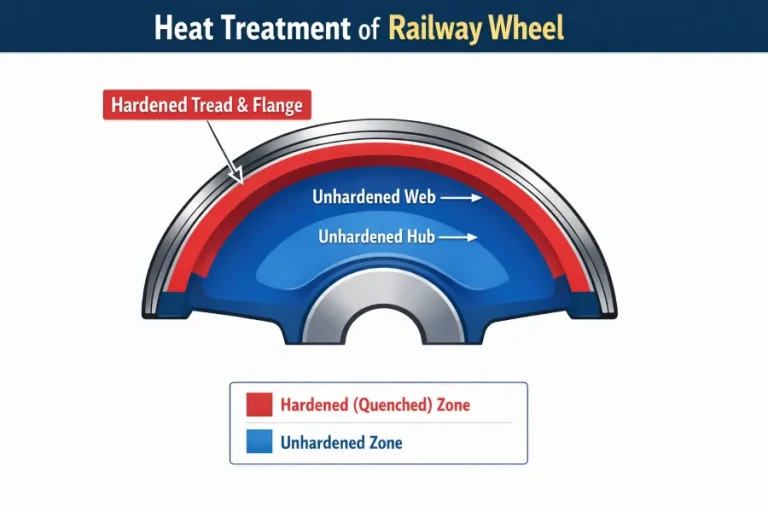
This is where the desired pearlitic microstructure is developed. Manufacturers carefully control temperature and cooling conditions to ensure that the wheel rim achieves the required balance of hardness, força, e resistência.
No entanto, manufacturing control alone is not enough.
Verification is just as important.
Metallographic examination allows engineers to observe the actual microstructure under a microscope. Rather than relying solely on hardness values, they can directly confirm the presence of pearlite and identify any undesirable phases.
Additional testing methods such as hardness testing, testes ultrassônicos, and other non-destructive inspection techniques provide further confidence that the wheel meets quality requirements before entering service.
Many people focus on dimensions because dimensions are easy to measure.
A wheel diameter can be checked in seconds. Hardness can be measured quickly as well.
Microstructure is different.
It cannot be evaluated with a simple visual inspection. Yet it often determines how the wheel will perform over the next several years.
This is why metallurgical inspection remains such an important part of railway wheel manufacturing.
When engineers examine a polished and etched sample under a microscope, they are looking for much more than just pearlite. They are evaluating the uniformity of the structure, checking for abnormal phases, assessing grain size, and identifying any signs of decarburization or process-related issues.
These inspections provide valuable information that dimensional measurements alone cannot reveal.
Em muitos casos, they help identify potential problems before the wheel ever enters service.
When discussing railway wheel performance, it is easy to focus on visible characteristics such as wheel diameter, dureza, or material grade. No entanto, the structure hidden inside the steel is often just as important.
The railway industry has relied on pearlitic railway wheels for decades because they provide a proven balance of wear resistance, desempenho de fadiga, e resistência. When non-pearlitic structures such as excessive ferrite, bainite, martensite, or Widmanstätten structures are present, that balance can be disrupted.
The result may not be immediate failure. More often, it appears as faster wear, earlier crack formation, maiores requisitos de manutenção, and reduced wheel life.
Por esta razão, leading wheel manufacturers place significant emphasis on metallurgy, tratamento térmico, and microstructural inspection throughout the production process.
At Train & Trilho, we understand that producing a reliable railway wheel involves far more than meeting dimensional requirements. No Luoyang Fonyo Indústrias Pesadas Co., Ltda. Our manufacturing process combines controlled steelmaking, precision forging, advanced heat treatment, and comprehensive inspection to ensure consistent microstructural quality and long-term performance.
Whether supplying railway wheels, rodados, eixos, ou custom railway casting components, we focus on the metallurgical details that ultimately determine safety, durabilidade, and service life in demanding railway applications.
If you have any requirements for railway wheels or railway parts, please tell us and our engineering team will always be here to support you.