Digitalize o código WeChat para entrar em contato conosco
Digitalize o código WeChat para entrar em contato conosco
Sinta-se à vontade para nos enviar um e-mail e responderemos o mais breve possível.
Criando o futuro com coração e alma


Now imagine you are on a fast train. The view outside moves back quickly, but the ride feels smooth and steady. You might think the tracks do everything. But there is another quiet hero behind this: o rodas ferroviárias.
These wheels carry the train’s weight, guide it on curves, and deal with speeding up and slowing down. Without good wheel design, even the best tracks would not keep the train safe. Hoje, we will look at how railway wheels are made to face these tasks — from their shape and materials to how they meet world standards.
Rodas ferroviárias pode parecer simples, but each part is important.
Flange: This small edge along the wheel keeps the train safely on the track on curves. You can think of it as a tiny guard for the train.
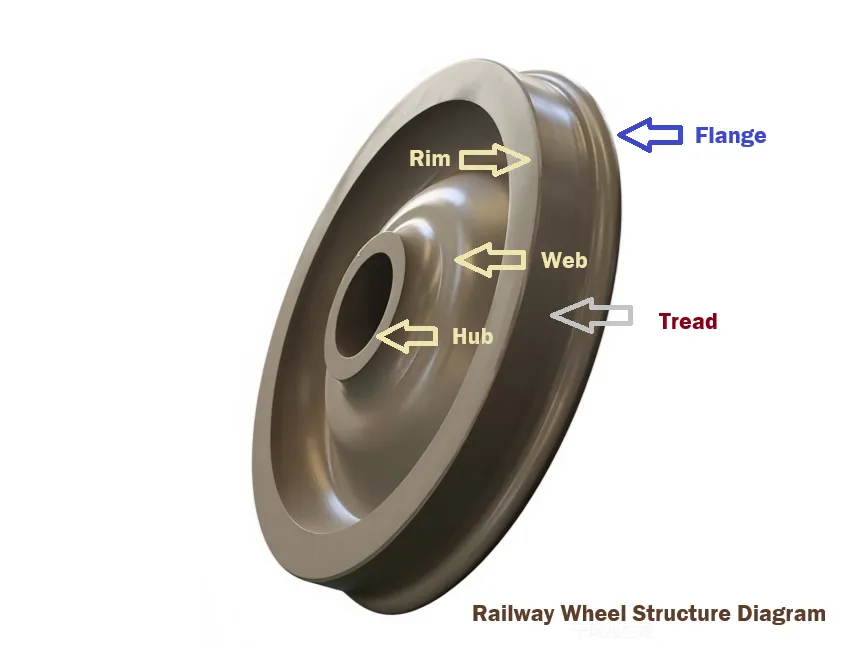
Piso: The flat part of the wheel that touches the rail. It holds most of the train’s weight and moves power from the engine to the tracks.
Wheel hub: The centre part that joins the wheel to the axle. It makes sure the wheel turns smoothly with the train.
Wheel profile: The curves and angles of the tread and flange are not by chance. They help the train guide itself through curves, lower friction, and reduce wear over time.
Even small changes in the wheel profile can change how the train rides. That is why engineers work a lot on getting every wheel’s shape just right.
If you want to know more about structure for Railway Wheels, you can read this to get more information
Rodas Ferroviárias: Estrutura e Função das Rodas
You may think thicker steel means stronger wheels. But designing a railway wheel is more than making it big.
Capacidade de carga: Wheel size and width are picked by train type. A freight train carries heavier loads, so its wheels are not the same as high-speed passenger train wheels.
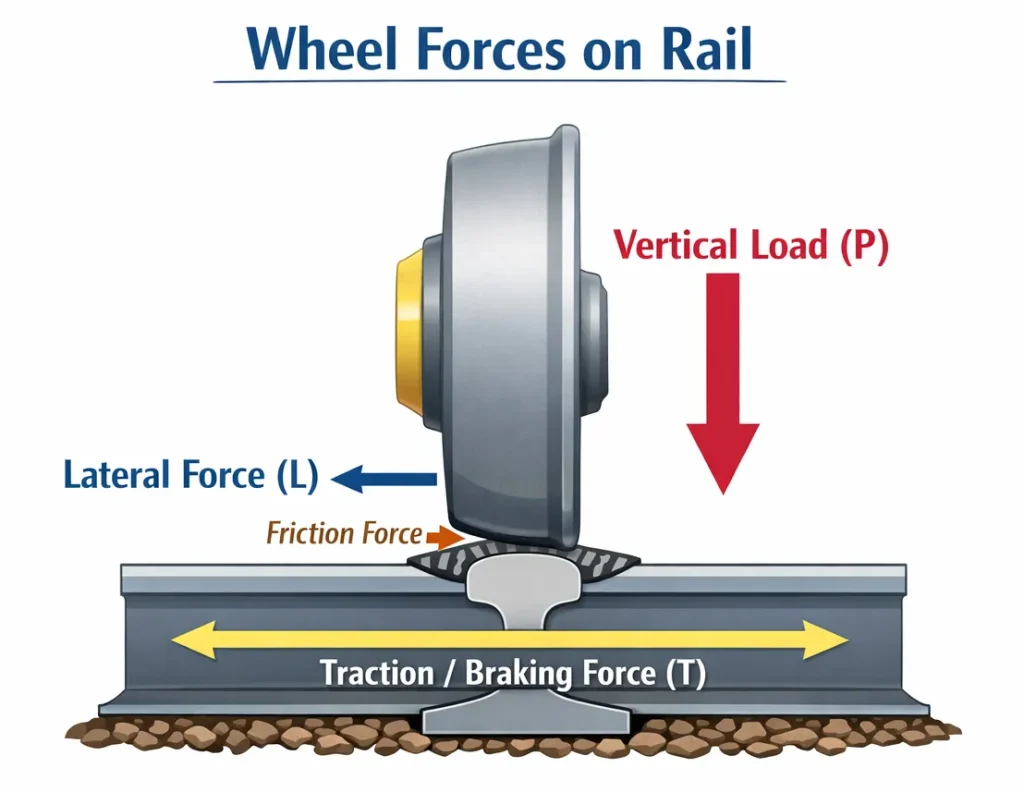
Friction and guidance: The angle where the wheel meets the rail helps guide the train on curves. It is like the wheel is “steering itself.”
Power transfer: Wheels do not only carry weight. They also move the engine’s pull to the track, helping the train speed up or slow down smoothly.
So every time a train speeds up, or slows down, or turns, the wheels are quietly handling huge forces. Without careful design, wheels could wear out fast, create too much friction, or even there is risk coming off the track.
The materials used for railway wheels are very important, they are relative to safety, vestir, and how long they last. There are two main choices:
Aço (carbon or alloy): steel is hard and strong, great for high-speed trains. Steel wheels are not likely to crack under stress and handle heavy use well.
Ferro dúctil (nodular cast iron): Good at resisting wear and costs less. It is often used for freight trains and some city rail systems.
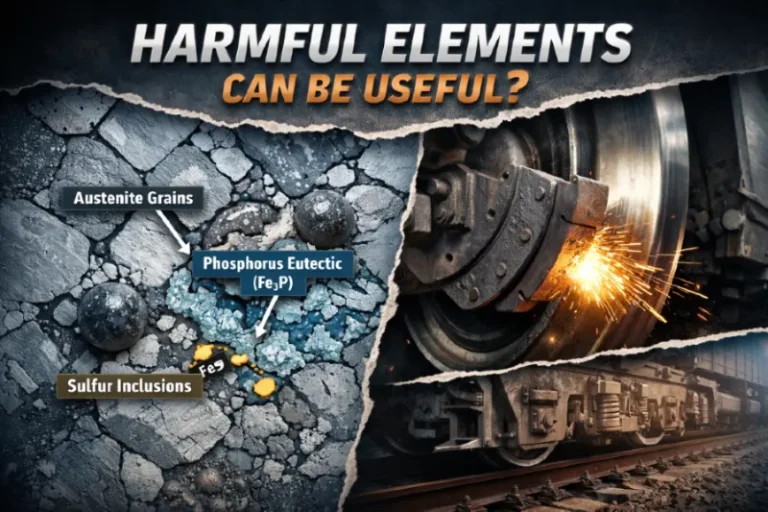
Heat treatment is another key step. Steps of heat treatment like quenching and tempering make the tread hard enough to resist wearing down, while keeping the hub strong to take shocks. This balance makes sure wheels can last for years in tough use. Dica: Nossa empresa, Luoyang Fonyo Indústrias Pesadas Co., Ltda. can make wheels with different materials and heat treatments for any train type, we can produce wheels according to your requirement for high-speed passenger, carga pesada, or city rail.
If you want to know more about heat treatment for Railway Wheels, you can read this to get more information
Tratamento térmico de rodas ferroviárias para resistência e segurança
The wheel’s tapered shape is not just for the shape simply, it is key for safe train movement. The shape can keep the train guide itself on curves and spreads forces evenly.
Wear is normal, and will always happen, but if we design the wheels properly, we can slow it down a lot. Regular checks, care, and reshaping worn wheels help them last longer. This is why train companies plan regular wheel maintenance, even for trains that look fine outside.
Railway wheels are not the same everywhere. Different countries have different rules:
UIC (Europa): Used in European and some Asian high-speed trains.
RAA (USA): Sets the needs for heavy freight wheels in the United States.
EM (Europa): Gives details on size, dureza, and other safety points.
Making wheels that meet these rules means they can be used safely around the world. Our wheels are produced according to these world standards in mind, so they work both at home and for export.
Rodas ferroviárias pode parecer simples, but they come from careful engineering. Eles carregam cargas pesadas, guide trains safely on curves, resistir ao desgaste, and meet world standards strictly. Every detail is important , from the wheel shape to the material and heat treatment.
If you need high-quality railway wheels and full wheelsets, Luoyang Fonyo Indústrias Pesadas Co., Ltda. is ready to help. Our wheels are made to exact measures, ensuring high accuracy and smooth running. We focus on quality, longa vida, and reliability, so your trains can run safely at any speed. Whether for high-speed passenger trains, carga pesada, or city rail systems, we have the skill to provide the right answer. Learn more on our website: www.railwaypart.com
Se você tiver algum requisito, entre em contato conosco.
WhatsApp: +86 15515351287
E-mail: [email protected]