Scan the WeChat code to contact us
Scan the WeChat code to contact us
Feel free to send us a massage and we will reply to you as soon as possible.
Creating the future with heart and soul


When discussing train speed, people usually talk about traction power, aerodynamics, or track quality. Railway Wheel precision is rarely mentioned.
Yet in real railway engineering, the maximum safe operating speed of a train is often determined by something far more subtle: the geometric accuracy of the railway wheels.
At high speeds, even tiny deviations in wheel diameter, roundness, or profile shape can trigger dynamic instability that no amount of motor power can overcome.
This is because speed, in railway systems, is ultimately governed by how stably the wheels interact with the rails—and this interaction is mediated by the bogie and its suspension system. The wheel provides the excitation; the suspension determines whether that excitation leads to stability or disaster.
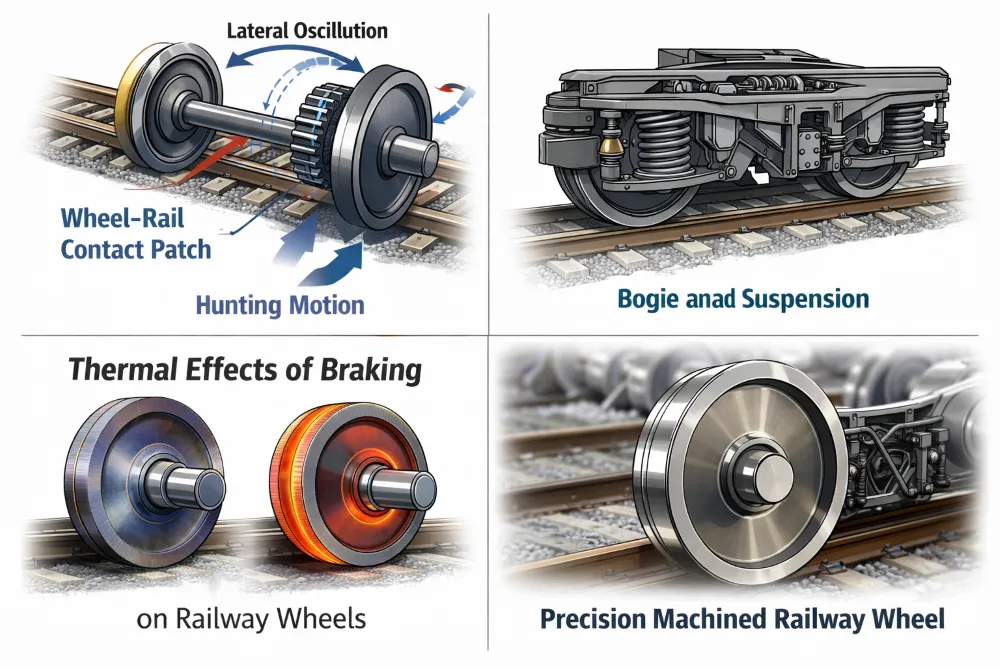
As train speed increases, the wheelsets begin to develop a lateral oscillation known as hunting motion. Below a certain speed, this oscillation is small and self-correcting. Beyond a critical threshold, it becomes unstable.
This critical speed is not random. It is directly influenced by the geometry of the wheel–rail contact—but it is ultimately determined by the coupled dynamics between the wheelset and the suspension system.
The contact between a steel wheel and a steel rail happens over a very small area called the contact patch. At higher speeds, the location and stress distribution within this patch change rapidly. If the wheel profile is not perfectly controlled, the contact point shifts unpredictably, generating lateral forces.
This is where the suspension comes in. The primary suspension (the springs and linkages connecting the wheelset to the bogie frame) is designed to absorb these forces and guide the wheelset back to center. However, if the excitation from the wheel-rail interface is too strong or too frequent due to geometric errors, the suspension can no longer dampen it out. The wheelset’s motion then couples with the mass of the bogie and car body, leading to full-system instability.
In simple terms: The more precise the wheel profile, the less work the suspension has to do, and the higher the speed at which the system remains stable.
Railway wheels are not simple cylinders. Their tread has a carefully designed conical profile that allows the wheelset to self-center on the track.
This self-centering behavior depends entirely on the exact geometry of the wheel profile. If the profile deviates even slightly from the intended shape due to machining error or wear irregularity, the self-centering effect weakens.
From a suspension perspective, a profile error creates a “wrong” steering signal. At low speeds, the suspension can filter out this noise. But at high speeds, the suspension receives a continuous, erroneous input. It tries to correct it, but instead, it feeds energy into the wheelset, creating a vicious cycle that lowers the critical hunting speed.
This is why high-speed railways impose extremely tight tolerances on wheel profile machining and regular reprofiling during service. The profile accuracy determines whether the suspension operates in a stable regime or is constantly fighting against geometric errors.
Railway Wheel diameter is usually discussed in terms of speed calculation, but its influence on dynamic stability is just as important.
If wheels on the same axle or within the same bogie have small diameter differences, the rolling radii become mismatched. This forces the wheelset to constantly correct its path, increasing lateral motion.
The impact on suspension is direct and damaging. The primary suspension is constantly twisted and stressed as it tries to keep the wheelset aligned. The faster the train runs, the higher the frequency of these parasitic forces. This continuous excitation can lead to premature wear of suspension components and, more critically, introduces a constant energy input that pushes the bogie closer to its instability threshold.
What appears to be a minor diameter tolerance at the workshop level can become a stability issue at 200 km/h—not just because of the wheelset itself, but because it overloads the suspension’s capacity to maintain stable running.
Perfect roundness is another critical factor. Out-of-round wheels or excessive radial runout introduce periodic vertical and lateral forces into the system.
At low speeds, these forces are absorbed by suspension. At high speeds, they excite vibrations in the bogie and suspension system, contributing to instability and passenger discomfort.
The suspension dynamics here are critical. If the frequency of these “out-of-round” impacts matches the natural frequency of the bogie’s unsprung mass (the wheelset, axlebox, and part of the suspension), resonance occurs. This magnifies the forces dramatically, leading to track damage, component fatigue, and a significant reduction in the critical speed of hunting motion.
This is why precision turning, balancing, and strict roundness control are essential for wheels intended for higher-speed applications. It is not just about smoothness—it is about avoiding resonant excitation of the suspension system.
During braking, wheels are exposed to intense heat. If the wheel material and heat treatment are not well controlled, thermal stresses can cause subtle distortions in the tread profile.
These distortions may be invisible to the eye but large enough to affect wheel–rail contact geometry at high speeds. From a suspension standpoint, these thermal distortions act as a slowly evolving geometric error. They change the input conditions that the suspension must manage, potentially pushing a previously stable bogie into an unstable regime as the train operates.
Thus, wheel precision is not only a machining issue but also a material and heat treatment issue—because thermal stability ensures that the wheel geometry presented to the suspension remains within design tolerances throughout the duty cycle.
In conventional railways, small geometric deviations in wheels may be acceptable. In high-speed railways, they are not.
This is why high-speed wheel standards focus heavily on:
Because at high speeds, wheel precision is no longer about wear life alone. It becomes a factor that directly defines the safe operating speed—through its interaction with the suspension system.
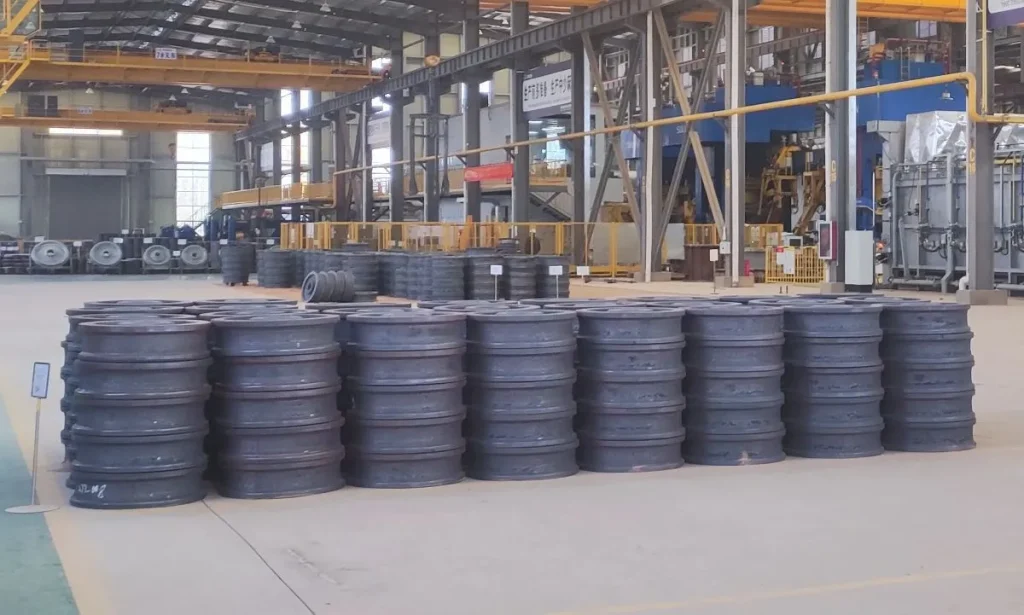
Train speed is often thought to be limited by power or aerodynamics. In reality, it is frequently limited by how precisely the wheels are manufactured and maintained—and how well that precision matches the suspension system’s capability.
Wheel geometry defines the excitation. Suspension dynamics define the system’s capacity to absorb that excitation. Together, they define the maximum safe speed.
Which leads to a simple but powerful conclusion:
The true speed limit of a train is set by the dynamic partnership between the railway wheel and the bogie that carries it.
Railway wheel precision is not just a matter of quality control or manufacturing pride. It is a fundamental engineering requirement for high-speed operation.
Diameter accuracy, profile geometry, roundness, and material stability all combine to determine how fast a train can safely run.
This is why modern railway engineering places extraordinary emphasis on wheel machining precision and profile control, because in high-speed rail systems, the smallest geometric details can define the largest performance limits. For this reason, railway wheelset precision is not only a matter of manufacturing quality, but a key factor in railway system performance.
At Luoyang Fonyo Heavy Industries Co., Ltd., our manufacturing process is built around strict control of wheel geometry, roundness, diameter consistency, and heat treatment behavior to meet the requirements of modern railway operations.
Learn more about our railway wheelset manufacturing capabilities:
www.railwaypart.com