Scan the WeChat code to contact us
Scan the WeChat code to contact us
Feel free to send us a massage and we will reply to you as soon as possible.
Creating the future with heart and soul


1.1. What is a Railway Spring?
The railway rail is a component that supports locomotives and determines their direction. The rail is fixed to the sleepers of the ballast bed through an elastic spring. The compression components of the elastic spring are mainly the spring, which generates a clamping force by bending and twisting the spring onto the track. This ensures a reliable connection between the rails for a long time, maintains the integrity of the track as much as possible, prevents longitudinal and lateral movement of the rails relative to the sleepers, ensures normal track gauge, and thus ensures the safety of railway vehicles. Additionally, since the contact between the train wheels and the rail is a rigid contact, vibrations are inevitable, and the special elastic structure of the spring enables them to absorb the impact energy generated by the passage of the train, achieving shock absorption. Spring work under repeated alternating stresses. They bear bending, torsion, fatigue, and corrosion, and endure extremely high instantaneous impact loads during vehicle passage. Therefore, the performance of spring is extremely demanding.
1.2. Features of Railway Spring
With the increase in axle load of railway locomotives and vehicles and the increase in train operating speed, as well as the development of urban rail transit and subways, springs as a key component of the track structure have also been continuously evolving, and their importance has increasingly attracted attention from various countries. China is a vast country with diverse climates, transportation conditions, and regional differences, requiring various performance requirements for spring to meet the needs of different tracks and rail types. For example, on conventional tracks, spring with high clamping force and good elasticity are needed to meet the requirements of heavy-load and high-speed lines; while in seamless track on high-bridge railways, to reduce the interaction force between the rails and the bridge, the resistance of the spring should be small, and the spring should have sufficient elasticity, that is, they should have a sufficiently low stiffness to ensure that the loss of clamping force caused by the compression of the sub-layers under the rails is very small and the spring do not loosen.
It can be seen that although a railway spring is a small engineering component, it is an important part of the track. Due to its large demand, there are approximately 7,000 pieces per kilometer, and its reliability directly affects the safety of train operation.
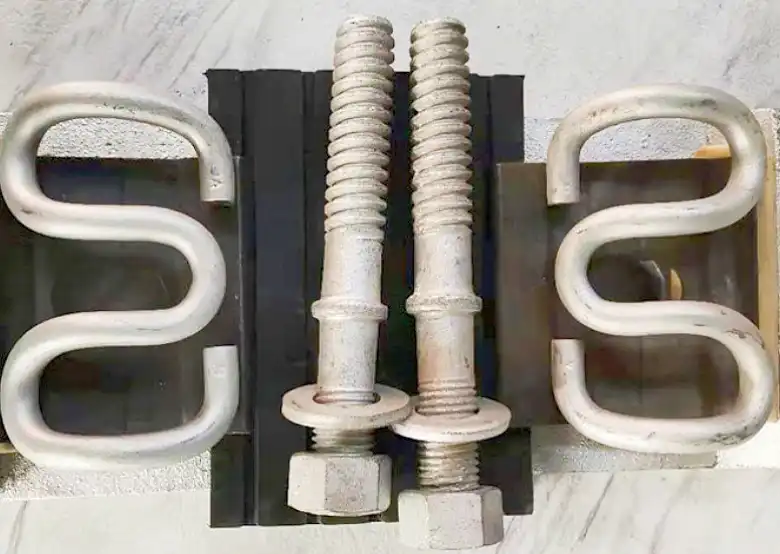
2.1. Depending on different national conditions and usage habits, various countries have developed multiple types of fastener compression components to adapt to the development of railway transportation. The most typical ones include: the PANDROL series fastener of the United Kingdom, which is the most famous and influential fastener in the world today, and its compression components use PR series and E series springs. Its application range covers more than seventy countries and regions in the United States, Canada, India, etc.
2.2. Germany’s railway extensively uses the renowned HM type spring, with compression components using the SKL series spring. They have achieved good results on the tracks and are also widely used in some other countries and regions.
2.3. The D.E. type spring of the Netherlands and the FIST spring of Switzerland both use springs as compression components, and their usage is also very good.
2.4. Japan and France use springs with plates as compression components. Among them, there is the famous French Nabler fastener, and the 102 type fastener on the Tokaido Shinkansen in Japan is very famous.
3.1. When springs are in operation, they mainly utilize the bending deformation properties of materials. The processing is relatively simple, but because they are bolted and have holes, stress concentration is likely to occur at this part, and the maximum bending moment is precisely at the weakest section of the cross-section. Our early developed arched fastener compression components, in use, were found that the bolts were prone to breakage when tightened, and the vibration generated by the train passing was likely to cause the spring to relax, and even some nuts would come out from the bolts. In addition, the gauge guard plates are prone to climbing onto the rail bottom under the action of vibration, causing the gauge to widen. Due to this situation, currently, DTⅠ and DTⅡ springs used on subway lines adopt elastic plates as the clamping components, while other railway lines no longer use elastic plate springs.
3.2 When the elastic plate spring works, they utilize the bending deformation property of the material and the torsional deformation property of the material (especially the circular cross-section elastic plates), thus having good elasticity and basically no cross-sectional weakening. Therefore, the material utilization rate is relatively high. On conventional railway lines, it is generally desired that the spring have a large clamping force and good elasticity. In this regard, elastic plate springs have obvious advantages. Currently, most of the railways in China and other rail transit systems use elastic plate springs. The forms of elastic plate springs in China mainly include: ω-structured elastic plates with bolt installation, such as type I and type II elastic plates used in Zhengjing, small resistance elastic plates of Shilongqiao, WJ-2 type elastic plates, etc.; Pantype without bolt installation, such as type III elastic plates, elastic plates used in DTⅥ spring, PR type elastic plates used in Guangzhou subway, etc. and other structural forms of elastic plates, such as double-toe elastic plates, middle elastic plates.
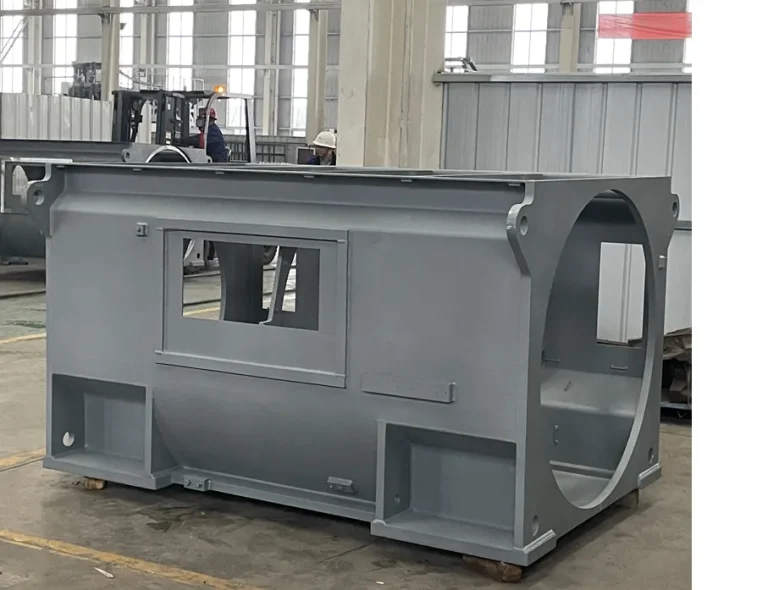
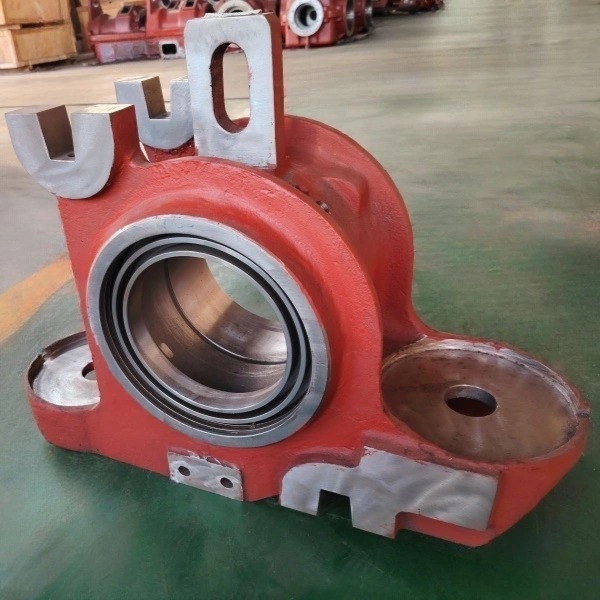
Luoyang Fonyo Heavy Industries Co., Ltd, founded in 1998,is a manufacturer in railway casting parts.Our factory covers an area of 72,600㎡, with more than 300 employees, 32 technicians, including 5 senior engineers, 11 assistant engineers, and 16 technicians.Our production capacity is 30,000 tons per year. Currently, we mainly produce casting, machining, and assembly for locomotive, railcar, high-speed trains, mining equipment,wind power,etc.
We are the railway parts supply to CRRC(including more than 20 branch companies and subsidiaries of CRRC),Gemac Engineering Machinery,Sanygroup, Citic Heavy Industries,etc. Our products have been exported to Russia, the United States, Germany, Argentina, Japan, France, South Africa,Italy and other countries all over the world.