Scan the WeChat code to contact us
Scan the WeChat code to contact us
Feel free to send us a massage and we will reply to you as soon as possible.
Creating the future with heart and soul


In metal industrial casting, people often say phosphorus and sulfur are bad. They are usually called “harmful impurities” in rule books, and their amounts are strictly limited.
But in real foundries, especially when making cast iron, things are more interesting. We still see iron with high phosphorus. We still meet melts with high sulfur. And in some uses, cast iron with these elements has worked well for years. So we need to ask:
Are phosphorus and sulfur always bad? Or can they be useful, depending on how and where we use them?
Let’s not look at them from a textbook. Let’s look from a factory floor view, let’s think about the material’s structure, what the part needs to do, and how we control the process in industrial casting.
This thinking has reasons.
In cast iron and steel, phosphorus likes to gather in certain spots when the metal becomescool and hardens. When there’s too much, it can form hard, brittle areas between grains. This makes the material weaker against impact and more likely to crack under force.
Sulfur causes a different issue. It forms compounds like FeS, and melts easily. During cooling, these can stay soft at the grain boundaries, making the material weak and brittle when hot (we call this “hot shortness”). That’s why we keep sulfur low in most steels and irons, unless we add enough manganese to balance it.
For parts that face shock or repeated stress, these worries are very real. We cannot allow brittle areas in such parts.
But sometimes, we apply these rules to every situation, without asking if the part really needs that.
In real casting, elements don’t act alone. What matters is:
How are they spread inside the material
What kind of structures do they make
Where those structures are
And, most of all, how the part is used when it’s working
Phosphorus and sulfur don’t always make things worse. They cause trouble only if they are in the wrong form, in the wrong place, or under the wrong kind of load.
A part made to handle impacts needs different things than a part made for wearing down slowly, creating friction, or keeping its shape. If we treat all parts the same, we miss important details.
In practice, good engineers don’t just ask if an element is good or bad.”They ask: “Does the material’s structure fit the job this part has to do?”
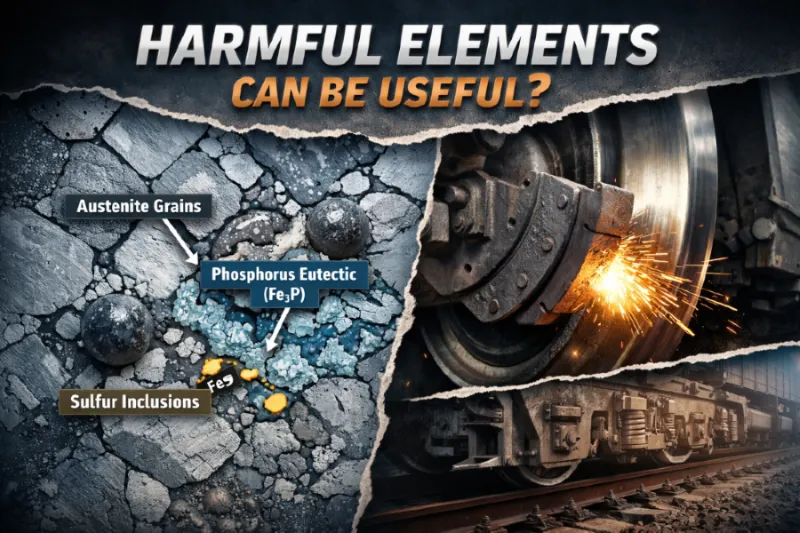
Parts that work under friction and wear follow different rules.
They usually need to:
Resist being worn away or stuck to another surface
Have steady friction over time
Get rid of the heat well
Wear down in a slow, predictable way
Work well with the surface they touch
Being tough against sudden hits is often not the main point. In brakes and many friction systems, the part’s job is not to absorb shocks. Its job is to turn movement into heat in a steady, controlled way.
Here, having some hardness and a non-uniform structure inside can actually help. It’s not always a problem.
This idea is key when we think about phosphorus and sulfur.
In cast iron, phosphorus makes very hard areas inside the metal. For toughness, these are bad. But for wear and friction, they can be very good.
In these uses, hard spots act like tiny, strong pillars on the surface. They help carry the load, resist changing shape, and stop surfaces from sticking together. Instead of a big patch of material smearing, the contact happens over many small hard points.
This leads to Better wear resistance, More stable friction, Less chance of surfaces seizing up.
So, phosphorus-rich areas can help a friction part work the same way for a long time.
This isn’t new. High-phosphorus cast iron has been used for a long time where wear matters more than impact strength. The secret was always control — not getting rid of it completely.
Sulfur is often seen as a pure troublemaker. In many cases, that’s true. But its behaviour changes based on what’s around it.
If sulfur combines with manganese to form MnS (not FeS), it becomes much less harmful. In some cases, small bits of sulfur compounds can even help manage how friction works.
In dry rubbing conditions, sulfur phases might help lower friction and improve wear. This doesn’t mean we should use a lot of sulfur. It means that with the right mix and process, sulfur doesn’t always make the material useless.
Again, it’s not about whether sulfur is there, but what form it takes.
Nothing here means we should use high-phosphorus iron carelessly. To use it well, we need careful control.
Important points are:
Controlling the chemical mix carefully
Balancing carbon and silicon levels
Having enough manganese to handle sulfur
Controlling how it solidifies to avoid connected brittle networks
Making sure the inner structure fits the expected load
When we manage these, high-phosphorus cast iron becomes a reliable engineering choice, not a gamble.
That’s why such materials aren’t used in parts that take heavy impacts, but are common in friction and wear jobs. The same element can be a problem or a tool, depending on whether the engineer understands and controls it.
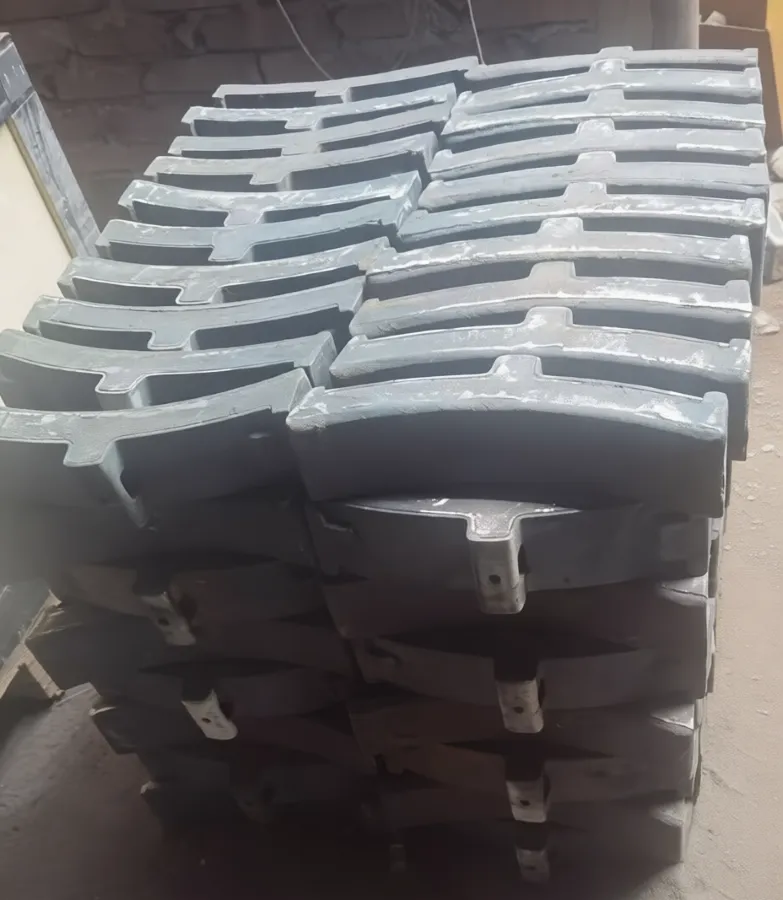
In industrial casting, phosphorus cast irons have a long history in parts that deal with friction. Their benefits are proven by decades of real use.
These materials offer:
Good wear resistance
Stable performance under dry friction
Predictable wear over time
They work well against steel surfaces
Crucially, these parts are designed knowing how the material behaves. We don’t ask them to do jobs they can’t handle.
Matching the material to the job is what good engineering is all about.
Based on this practical way of thinking, Luoyang Fonyo Heavy Industries Co., Ltd. makes cast iron brake shoes for railways. This includes solutions using high-phosphorus cast iron, where wear resistance and steady friction are most important. You can find more about these products at www.railwaypart.com
Phosphorus and sulfur are often called harmful, and often they are. But casting is not about rules that are always true. It’s about knowing where a material fails and where it succeeds.
This practical mindset is also how we develop products at Luoyang Fonyo Heavy Industries Co., Ltd. As a supplier of railway castings, locomotive wheels, and cast iron brake shoes, we choose materials not by a fixed formula, but by what the real working conditions demand. In uses ruled by friction and wear, like railway brakes, this lets us use so-called “bad” elements on purpose, instead of just avoiding them. More details are at www.railwaypart.com