Scan the WeChat code to contact us
Scan the WeChat code to contact us
Feel free to send us a massage and we will reply to you as soon as possible.
Creating the future with heart and soul


When you see a wind turbine rotating steadily in the wind, do you ever wonder which core component supports it all? That critical part is the wind turbine generator housing—the very component entrusted with this essential role. Its manufacturing quality directly determines whether the entire unit can operate safely and reliably over the long term.
Today, we’ll explore the key process behind manufacturing large castings for wind turbine generator housings and explain why we’ve chosen CO₂ shielded welding (CO₂ welding) to produce these parts. This method ensures our products deliver both exceptional cost-effectiveness and outstanding reliability.
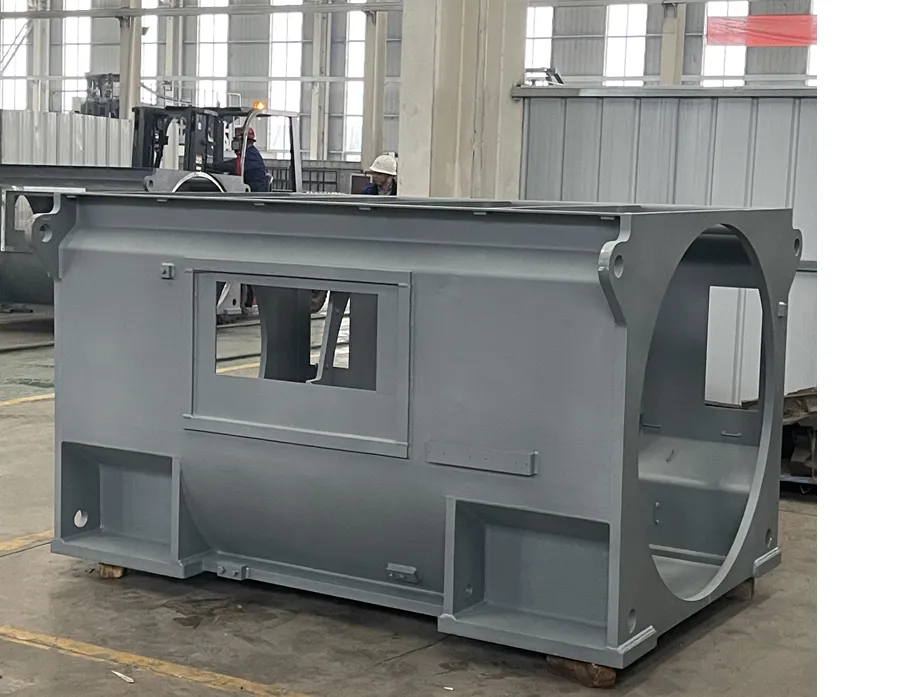
Production of wind turbine generator housing is not easy; it has several major challenges. First, the thick-plate structure demands deep weld penetration and high joint strength. Second, long and complex weld paths make manual operations difficult and inconsistent. Third, the large dimensions and high precision demand is also a big challenge; these aspect requirements necessitate specialised tooling and automation. Finally, the combination of castings and steel plates poses challenges in welding compatibility and joint performance.
To address these challenges, we adopt a CO₂ shielded welding process, this technology also known as the MAG welding process. It is a mature process, and it offers distinct advantages for fabricating heavy steel structures like the wind turbine generator housing.
The concentrated arc heat of CO₂ welding allows for deep penetration, perfectly meeting the strength requirements of thick-walled structures and ensuring the wind turbine generator housing can withstand heavy loads and long-term fatigue.
This continuous wire-feeding process is fast and suitable for automation. This means shorter production time, less manual labour, and effectively lower overall manufacturing costs for the wind turbine generator housing.
We employ robotic and semi-automatic welding systems. Even for long and complex weld paths, every seam remains uniform, sound, and reliable, greatly enhancing production efficiency and product consistency for the wind turbine generator housing.
CO₂ gas is an industrial by-product, much cheaper than inert gases like argon. Combined with cost-effective welding wire, this results in significant material cost savings in the mass production of large castings.
This process is well-suited for welding castings and low-alloy steels. Through proper wire selection and parameter optimisation, it effectively reduces the risk of weld cracks, ensuring the integrity of composite structures in the wind turbine generator housing.
CO₂ welded joints offer superior mechanical properties, strong fatigue resistance, and good corrosion resistance. This guarantees the long-term stable operation of the wind turbine generator housing in harsh outdoor environments.

In our factory, CO₂ welding is not a single step but a mature manufacturing system tailored for the wind turbine generator housing.
Automation Combined with Tooling: For oversized wind turbine generator housings, we use dedicated positioning fixtures and manipulators, integrated with robotic welding, to ensure every weld is precisely placed.
Rich Parameter Expertise: We have a verified database of welding parameters for different thick-plate and casting sections, ensuring optimal penetration and weld formation.
Strict Quality Inspection: Post-welding, we conduct Ultrasonic Testing (UT), Magnetic Particle Testing (MT), and detailed visual inspections to “examine” every seam, ensuring zero defects internally and on the surface.
Through this approach, we achieve a balance between cost control and quality enhancement, delivering truly high-value products to our customers.
So as we see, using the CO₂ shielded welding process for manufacturing large wind turbine generator housings provides three core benefits:
5.1 Enhanced Product Reliability: High-strength, fatigue-resistant welded joints extend the turbine’s service life.
5.2 Reduced Production Costs: Savings on gas, materials, labour, and time make the final wind turbine generator housing more competitive.
5.3 Supports Scalable Production: The mature, stable process is easily automated and standardised, perfectly suited for the high-volume, high-quality manufacturing needs of the wind industry.
In an era focused on reducing the levelized cost of energy (LCOE) for wind power, every process choice in manufacturing is critical. CO₂ shielded welding has proven its long-term value in manufacturing large wind turbine generator housings through its mature, efficient, reliable, and economical characteristics.
Choosing the right welding process is choosing the future of the product. Luoyang Fonyo Heavy Industries Co., Ltd. will go on study and work on this area and actively integrate more advanced automation and intelligent control technologies, ensuring this classic process continues to contribute to building stronger, more durable, and more cost-effective products. If you want to get more information about us, please visit our website www.railwaypart.com
If yo want to read more about our wind turbine generator housing, please click here:
Wind Turbine Generator Shell Energize Green Energy
Why Wind Turbine Castings Matter For High-Weather-Resistance
Key Points in Casting Low-Temperature Ductile Iron
Why Use Ductile Iron for Wind Turbine Generator Housing? – Rail Industry Casting Specialists