Scan the WeChat code to contact us
Scan the WeChat code to contact us
Feel free to send us a massage and we will reply to you as soon as possible.
Creating the future with heart and soul


When people talk about the quality of railway wheels, they usually think about things they can see or measure easily, such as dimensions, surface finish, or hardness. These factors are important, but in real operation, many serious problems do not start on the surface. Instead, they begin deep inside wheels, where visual inspection cannot help. Small internal defects may already exist after manufacturing, and although they are hidden at first, they can slowly grow during service. This is why internal inspection is such an important part of quality control for railway wheels.
During daily operation, railway wheels work under heavy loads and repeated stress. They face lots of chanllenges, and experience rolling contact fatigue, impact forces, and thermal stress from braking. Under these conditions, the wheels must have perfect quality, even small internal defects can become dangerous over time. Porosity, shrinkage, inclusions, or tiny cracks inside railway wheels may act as weak points. At the beginning, there may be no visible sign of damage, but after long-term use, these defects can expand and lead to spalling, cracking, or even sudden failure. Therefore, if we want to truly control risk, we must understand what is happening inside wheels, not only on the outside.

To check the internal condition of railway wheels without damaging them, non-destructive testing is essential. Unlike destructive methods, non-destructive testing allows every inspected wheel to remain usable if it meets quality requirements. Among different non-destructive techniques, ultrasonic testing has been widely used for many years. However, traditional ultrasonic testing has clear limitations when applied to railway wheels, which are large, heavy, and geometrically complex. Fixed beam angles and limited coverage may leave blind areas, and these blind areas can hide critical defects.
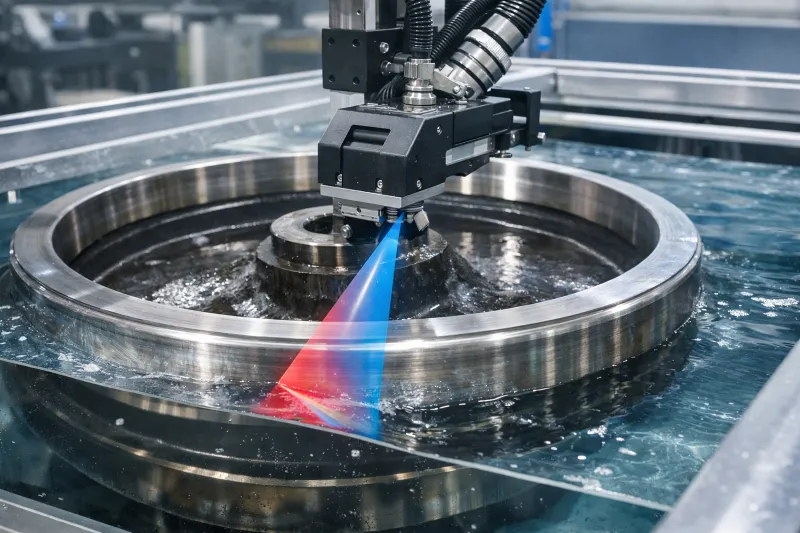
To solve these problems, we use water immersion phased array ultrasonic testing. In simple terms, this technology helps us see inside railway wheels more clearly and more completely. First, the inspection is performed in water, which provides stable and uniform ultrasonic coupling. Because of this, the influence of surface condition and curved geometry is reduced, and the inspection results become more consistent across different areas of railway wheels.
At the same time, phased array technology allows the ultrasonic beam to change angle and focus electronically. Instead of using one fixed beam, the system can scan the internal structure of wheels from multiple directions and depths. As a result, areas that are difficult to inspect with traditional methods become much easier to evaluate.
Because of this combination, water immersion phased array ultrasonic testing is especially suitable for railway wheels. It allows us to inspect critical zones such as the rim, web, and hub with fewer blind areas. During inspection, internal defects inside railway wheels reflect ultrasonic signals, which are then collected and displayed as clear images. These images help inspectors understand not only whetherthere is a defect exists, but also where it is located and how large it might be.
Compared with traditional ultrasonic testing, this method offers better accuracy and repeatability. It also reduces dependence on operator experience, which means inspection results are more stable and easier to trace. For manufacturers, this is very necessarym, because this leads to more reliable quality control of railway wheels.
One of the biggest advantages of this inspection method is early detection. By finding internal defects before railway wheels are delivered, unsafe products can be removed from the supply chain. This early control helps prevent failures during operation and reduces long-term risks. At the same time, inspection data provides useful feedback for improving manufacturing processes related to railway wheels, including casting, forging, and heat treatment.
Water immersion phased array ultrasonic testing is not used alone. It is part of a complete quality assurance system for railway wheels. Along with material control, there are some other inspection which are also very important, such as chemical analysis, heat treatment monitoring, mechanical testing, and dimensional inspection, ultrasonic testing acts as a final safety check. Each step adds another layer of protection, making sure every railway wheel reach strict quality expectations.
From the customer’s point of view, advanced inspection brings real value. When buyers choose railway wheels that have been inspected with water immersion phased array ultrasonic testing, they gain greater confidence in safety and consistency. For railway operators, this means some aspects, such as lower failure risk, fewer unexpected maintenance issues, and more stable long-term performance. In the end, reliable railway wheels help protect not only equipment, but also people and operations.
Ensuring the safety of wheels is never about a single process. Instead, it is the result of many careful decisions made throughout manufacturing and inspection. Water immersion phased array ultrasonic testing is one of those decisions that truly makes a difference. By investing in advanced inspection technology, we do more than simply meet basic requirements—we take real responsibility for the safe and reliable performance of wheels in real railway service. This same commitment is reflected in every railway wheel we manufacture and supply. At Luoyang Fonyo Heavy Industries Co., Ltd., we combine strict material control, controlled heat treatment, and advanced internal inspection to deliver railway wheels that customers can trust. To learn more about our products and quality control approach, please visit www.railwaypart.com.
Looking for project-specific railway components?
Our team manufactures and supplies railway castings and components — including wheels, brake shoes, bogie parts, gearbox housing, axle box housing, stator end priss rings, and track-related iron & steel castings.
Contact us to discuss your operating conditions and technical requirements.
Email: sales@railwaypart.com
WhatsApp: +86 15515351287