Scan the WeChat code to contact us
Scan the WeChat code to contact us
Feel free to send us a email and we will reply to you as soon as possible.
Creating the future with heart and soul


If you ask an engineer why a railway casting is made from cast steel, and a wind power component is often made from ductile iron, you’ll usually hear answers like “strength,” “toughness,” or “fatigue resistance.”
All of that is true. But it’s only the surface.
The real difference goes much deeper, down to how engineers think about what happens inside the metal.
And interestingly, that way of thinking is very different for cast steel and ductile iron.
Let me explain it in a simple, practical way.
Here’s something many people don’t realize:
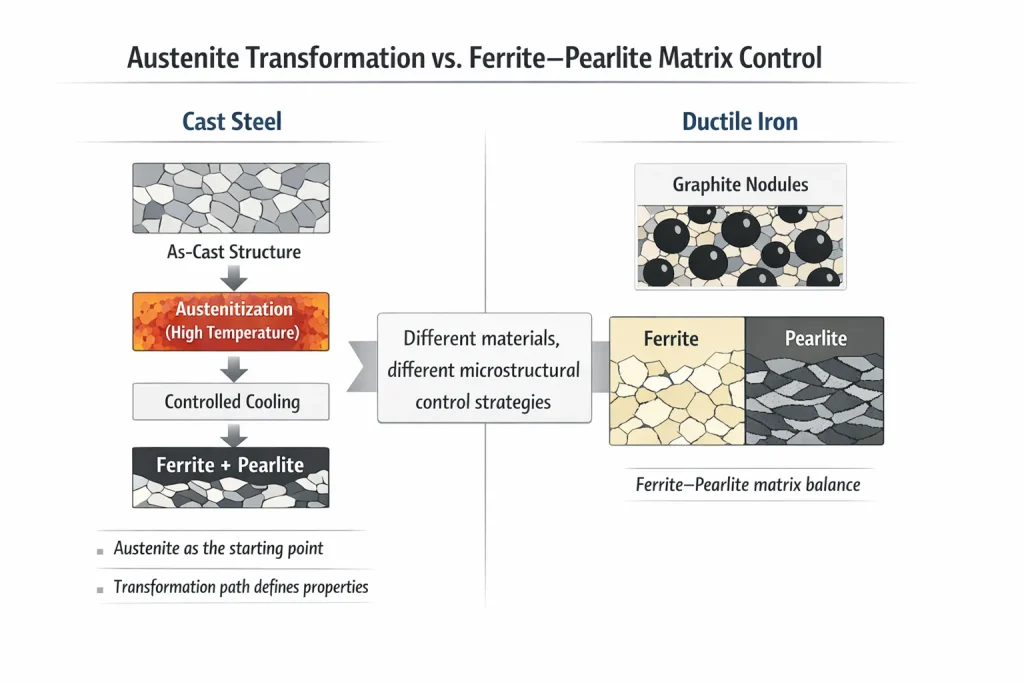
When engineers work with cast steel, they often start the conversation with austenite.
When they work with ductile iron, they focus much more on ferrite and pearlite.
This isn’t academic habit.
It reflects two very different engineering strategies for controlling performance in large industrial castings, especially in demanding fields like railway equipment and wind power.
Let’s start with cast steel, especially for railway applications.
Large railway castings such as structural parts, load-bearing components, or safety-critical elements — almost never go into service “as cast.”
They are always heat treated.
And every meaningful heat treatment starts the same way:
By forming austenite.
You can think of austenite as a kind of reset state for steel.
When cast steel is heated into the austenitic range:
The original coarse casting structure is broken down
Chemical segregation is reduced
Grain size can be refined
Mechanical properties become controllable
From there, engineers decide how the steel should cool and temper, depending on what the part needs to do.
In other words, austenite is not the final goal, but without it, there is no real control over strength, toughness, or fatigue life.
That’s why, when railway engineers discuss cast steel, they talk so much about:
Austenitization temperature
Holding time
Cooling rate
They’re really talking about how to guide the transformation from austenite into something useful.
Here’s an important point that often causes confusion:
Railway cast steel parts do not work in an austenitic state.
After heat treatment, the final microstructure is usually:
Ferrite + pearlite, or
A tempered structure designed for high toughness
This combination offers:
Good strength
Reliable impact resistance
Stable fatigue performance under repeated loads
That balance is exactly what railway applications need.
Trains don’t just carry weight — they accelerate, brake, vibrate, and experience shocks thousands of times over their service life.
So although austenite disappears before the part goes into service, the entire performance of cast steel depends on how that austenite was created and transformed.
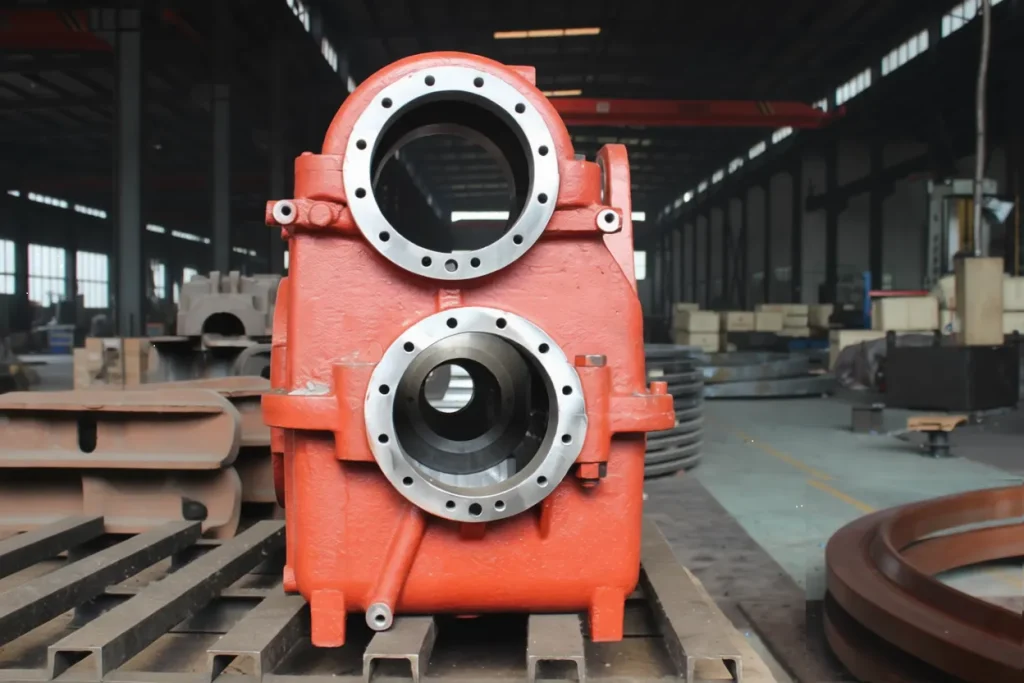
Now let’s switch to ductile iron, which is widely used in both railway auxiliary components and wind power equipment.
Here, the engineering focus changes.
With ductile iron, the key breakthrough is not heat treatment — it’s graphite shape.
When graphite forms as spheres instead of flakes, the metal suddenly becomes much tougher and more reliable.
Once that is achieved, engineers turn their attention to the matrix around the graphite.
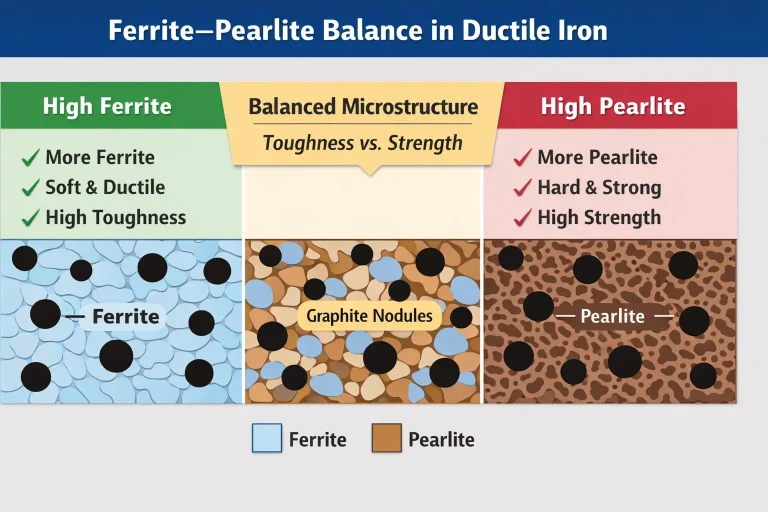
And this is where ferrite and pearlite take center stage.
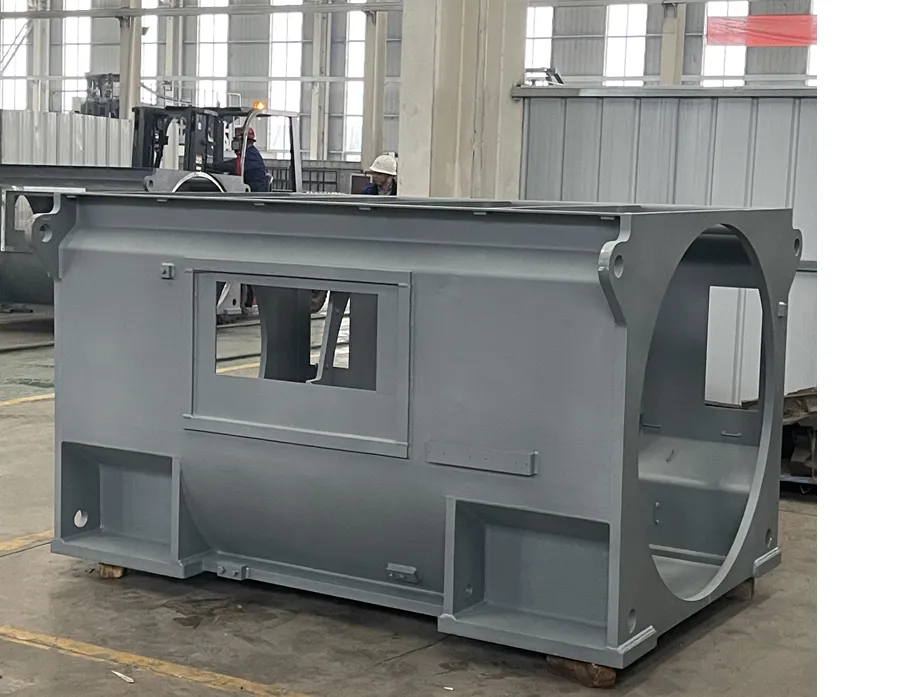
In most ductile iron applications, performance is adjusted by controlling the proportion of:
Ferrite — soft, tough, and ductile
Pearlite — stronger, harder, and more wear-resistant
By adjusting composition, cooling rate, and processing, manufacturers can choose:
Ferritic ductile iron for better toughness and elongation
Pearlitic ductile iron for higher strength and wear resistance
Or a balanced mix of both
This is especially useful in wind power components, where parts must:
Carry large static loads
Survive continuous cyclic stress
Maintain long service life with minimal maintenance
Instead of asking, “How do we transform austenite?”
Engineers ask, “What ferrite–pearlite balance gives us the best result?”
This leads to an interesting comparison.
For cast steel, especially in railway applications:
Engineers control transformation paths
Austenite is the key starting point
Heat treatment defines performance
For ductile iron, often used in wind power:
Engineers control matrix balance
Ferrite and pearlite dominate the discussion
Composition and cooling do most of the work
Different materials, different tools, but the same goal:
safe, reliable, long-lasting components.
From the outside, two castings might look similar.
Inside, they can be completely different.
Understanding whether a component’s performance depends on:
how austenite transforms, or how ferrite and pearlite are balanced
is what separates routine casting from high-reliability industrial manufacturing.
In industries like railway transportation and wind power, that understanding isn’t optional — it’s essential.
This article is part of our Inside Industrial Casting series, exploring engineering principles behind industrial casting materials and processes.
You may also be interested in:
At Luoyang Fonyo Heavy Industries Co., Ltd., we produce large cast steel and ductile iron components for railway equipment and wind power systems.
Instead of relying only on material grades or strength numbers, we focus on what truly matters:
Controlled austenitization and transformation in cast steel
Stable ferrite–pearlite matrix design in ductile iron
That microstructural focus allows us to deliver castings with consistent quality, predictable performance, and long service life.
If you’d like to learn more about how we approach railway and wind power castings from the inside out, visit us at
www.railwaypart.com for more information and contact us.