Scan the WeChat code to contact us
Scan the WeChat code to contact us
Feel free to send us a email and we will reply to you as soon as possible.
Creating the future with heart and soul


Large industrial castings are never just about size. In railway and wind power projects, a casting often becomes a key load-bearing or safety-related component. If its quality is unstable, the whole system can be affected. This is why choosing the right casting process matters so much, especially for railway castings that work under repeated loads and long service cycles.
At first glance, sand casting may sound simple. In reality, when it comes to large railway castings and wind power components, the process must be stable, controllable, and proven in real production. This is where furan resin sand casting plays an important role.
To put it simply, furan resin sand casting is a cold-setting sand process. The sand is mixed with resin and a hardener, and it gains strength at room temperature. There is no need for baking. This may sound like a small detail, but for large molds, it makes a big difference.
Because the mold hardens naturally, it becomes much easier to handle large sizes and complex cores. For many heavy parts, including railway castings, this process offers a good balance between strength, flexibility, and production efficiency.
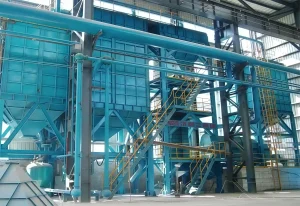
When producing large castings, size is only one part of the challenge. Stability is the real concern. Large railway castings often have thick sections, ribs, and box-like structures. If the mold is not strong enough, deformation can happen even before pouring.
Furan resin sand provides high mold strength, which helps maintain shape during pouring and cooling. At the same time, it allows enough flexibility to create complex internal cavities. This is especially important for railway castings, where dimensional consistency directly affects assembly and service performance.
Another reason is cost control. Large components are often produced in small or medium batches. In this situation, furan resin sand casting remains economical while still delivering reliable quality.
How the Process Behaves in Actual Railway Castings Production
In real workshop conditions, the value of furan resin sand casting becomes clearer. Sand mixing and curing speed can be adjusted to match mold size and ambient conditions. This helps control mold strength more precisely.
At the same time, the rigid mold structure helps reduce deformation during pouring. For large railway castings, this stability is critical. It supports better dimensional accuracy and reduces the risk of rework later.
Of course, the process also generates gas during pouring. This means surface quality and internal cleanliness depend heavily on proper control, not only on the material itself.
No casting process is perfect, and furan resin sand casting is no exception. In large railway castings, gas-related defects such as gas pores or pinholes are common concerns. The larger the casting, the harder it is for gas to escape naturally.
Surface issues can also appear. Sand sticking or rough surfaces often result from high pouring temperatures combined with large contact areas. These problems increase cleaning work if not controlled early.
Mold strength is another balancing point. If the mold is too soft, deformation may occur. If it is too hard, collapsibility becomes poor, and cleaning becomes difficult. For railway castings, both situations can affect dimensional stability.
Seasonal changes also play a role. Temperature and humidity shifts between summer and winter directly influence curing behavior. Ignoring these changes often leads to inconsistent results.
In daily production, quality does not improve because of one single change. It improves step by step. The sand ratio is adjusted according to the size and structure of the mold, instead of following one fixed formula for all parts.
When selecting the binder and hardener, curing speed and gas control are always considered together. For large railway castings, the design of venting and gating systems is also important. It allows gas to escape smoothly during pouring and helps reduce internal defects.
At the same time, good results depend on discipline on the shop floor. Stable sand mixing, controlled molding time, and clear operating rules help keep the process consistent. Over time, these small but steady controls lead to reliable and repeatable quality.
Although the same furan resin sand casting process is used, the focus of control is not the same. For railway castings, dimensional consistency and repeatability are key. These parts must fit accurately and perform reliably under cyclic loads.
Wind power castings, on the other hand, place more emphasis on internal quality and overall stiffness. Defect tolerance is lower, and inspection requirements are often stricter. Understanding these differences helps adjust process priorities accordingly.
What This Means for Customers
From a customer’s point of view, the real value of furan resin sand casting is not the process name itself. It is the confidence that large railway castings and wind power components can be produced with predictable quality and stable delivery.
With proper process control, customers benefit from reduced risk, fewer quality surprises, and better cost planning. This is especially important for large projects where delays or rework can be expensive.
Furan resin sand casting is not just a technical option. For large railway castings and wind power components, it represents years of production experience and continuous optimization. At Luoyang Fonyo Heavy Industries Co., Ltd. this process is applied with discipline and understanding, becoming a reliable foundation for producing large, complex, and critical castings. Please visit our website to get more information about us. www.railwaypart.com