Scan the WeChat code to contact us
Scan the WeChat code to contact us
Feel free to send us a email and we will reply to you as soon as possible.
Creating the future with heart and soul


When a railway vehicle runs smoothly along the track, most people focus on the train itself. But in reality, much of that safety and stability comes from what is underneath — the running gear. The running gear is one of the most important systems in a railway vehicle. It brings together several key railway parts that allow the train to move, carry heavy loads, absorb shocks, and stop safely when needed.
The running gear refers to the parts of a railway vehicle that directly interact with the rails.
It supports the weight of the vehicle, guides it along the track, and helps it pass curves smoothly.
More importantly, it transfers all forces between the vehicle and the rail. These include vertical loads, traction forces, braking forces, and impacts caused by track conditions. Without a well-designed running gear, safe and stable railway operation would not be possible.
In modern railway vehicles, the running gear is not a single component. It is a system made up of several essential railway parts working together.
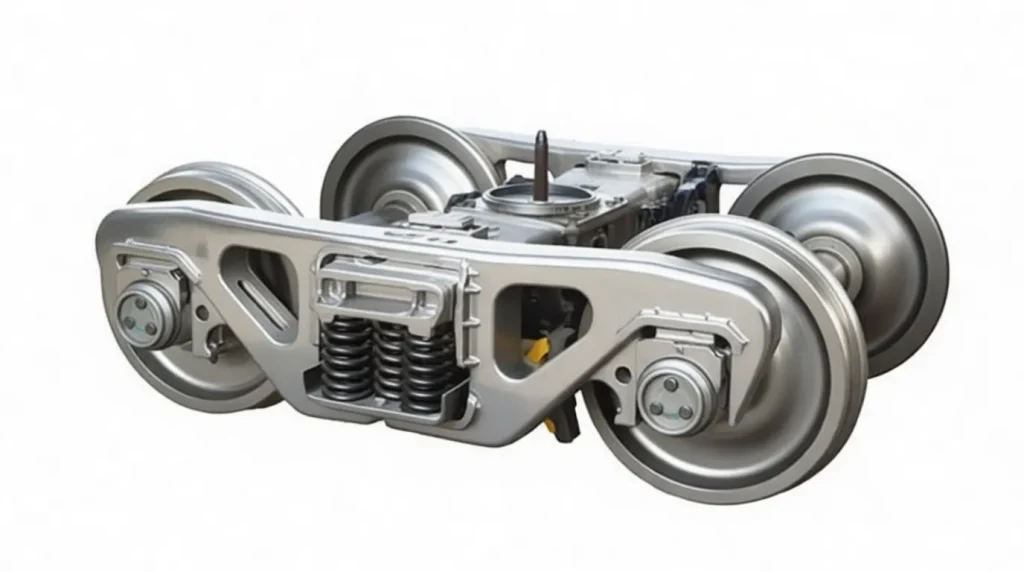
At its core, the running gear has a few clear tasks. It ensures that the vehicle can run safely and smoothly along straight tracks and through curves, carries the weight of the car body while transferring that load evenly to the rails, and reduces vibration as well as absorbs shocks to protect both the vehicle and the track. Additionally, it provides a stable foundation for braking, allowing the train to slow down and stop reliably. All of these functions depend on the quality and coordination of the railway parts involved.
In the early days of railway development, vehicles were relatively light.
Many trains used a simple two-axle design, where the wheelsets were mounted directly under the car body. These vehicles did not use bogies, and their structure was straightforward.
As railway transport evolved, trains became heavier, faster, and more complex. The simple structure was no longer enough. Vehicles needed better stability, improved curve negotiation, and higher load capacity.
This is where the railway bogie became essential.
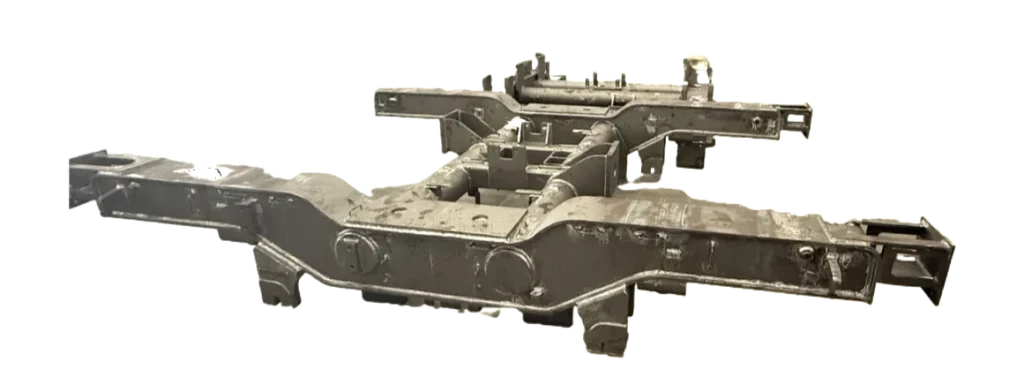
A bogie groups two or more wheelsets into a single frame. This allows the vehicle to distribute loads more evenly and move more smoothly, especially on curves and uneven tracks. Today, railway bogies are a standard part of most passenger and freight vehicles.
A railway bogie acts as a platform that connects several critical railway parts into one working unit. It holds the wheelsets in position, guiding them along the rail, while also supporting suspension components that absorb vibration and reduce impact, and carrying braking equipment to ensure reliable stopping performance. By allowing limited movement between the bogie and the car body, the bogie improves ride stability and reduces stress on both the vehicle and the track, making it a key element in modern running gear design.
Among all railway parts, railway wheels have one of the toughest jobs.
They are in constant contact with the rail. They carry heavy loads, endure repeated stress, and face wear from braking and traction. At the same time, they must maintain precise shape and strength to ensure safe operation.
The material, manufacturing process, and heat treatment of railway wheels all have a direct impact on service life and performance. Well-made wheels help reduce maintenance costs and improve long-term reliability of the entire running gear.
This is why railway wheels are never just “simple parts” — they are safety-critical components.

What makes the running gear truly effective is not any single component, but how all the railway parts work together.
Bogie provides structure and stability.
Wheelsets guide and support the vehicle.
Suspension reduces vibration and impact.
Braking system ensures control and safety.
When these parts are designed and manufactured as a coordinated system, the result is better performance, longer service life, and safer railway operation.
From a practical point of view, the quality of railway parts depends heavily on manufacturing experience.
Producing bogies and railway wheels requires a deep understanding of loads, materials, and real operating conditions. Consistent quality control, proper processes, and compliance with railway standards all play a critical role.
For operators and buyers, choosing reliable railway parts is not just about specifications. It is about long-term performance, safety, and trust.
As railway vehicles continue to operate under higher loads and more demanding conditions, the importance of reliable running gear becomes even clearer.
In practice, this reliability comes from well-designed railway bogies and high-quality railway wheels that are engineered to work together as a complete system.
For manufacturers and operators, focusing on these core railway parts is not just about meeting technical requirements. It is about ensuring long-term safety, stable operation, and consistent performance throughout the service life of the vehicle.
For manufacturers and operators, focusing on these core railway parts is not just about meeting technical requirements. Ensuring long-term safety, stable operation, and consistent performance is what Luoyang Fonyo Heavy Industries Co., Ltd. delivers through its high-quality railway bogies and wheels. Learn more at www.railwaypart.com