Digitalize o código WeChat para entrar em contato conosco
Digitalize o código WeChat para entrar em contato conosco
Sinta-se à vontade para nos enviar um e-mail e responderemos o mais breve possível.
Criando o futuro com coração e alma


Quando você olha pela primeira vez para um rodas ferroviárias, parece quase simples demais para ser importante. Apenas uma roda de aço rolando sobre um trilho de aço.
Mas há uma pequena característica que torna todo o sistema ferroviário seguro e estável: a flange da roda.
Então, por que as rodas ferroviárias têm flanges? E por que esse detalhe é tão crítico na engenharia ferroviária?
Vamos examinar isso de forma simples, maneira prática.
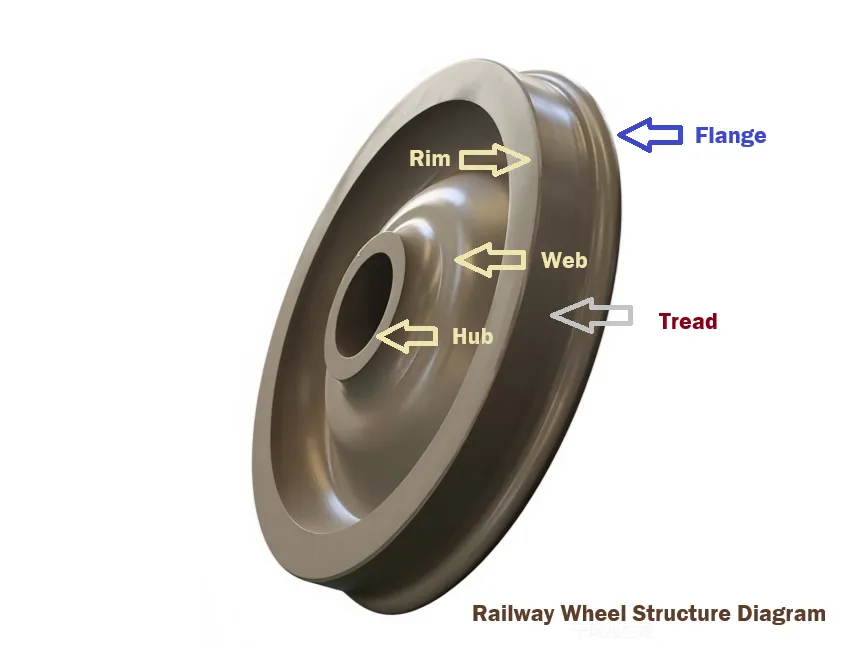
O roda ferroviária flange é a borda interna elevada de uma roda.
Se você olhar para uma roda por dentro, você verá uma borda ligeiramente mais espessa que fica mais alta do que a superfície de corrida. Essa é a flange.
Uma roda ferroviária padrão geralmente tem três partes principais:
Na maioria dos sistemas ferroviários, incluindo vagões de carga e trens de passageiros, the flange is always located on the inside of the track.
It looks simple, but its role is extremely important.
The short answer is:
👉 to keep the wheel safely guided on the rail track
But in real railway engineering, the reason is more detailed than just “preventing derailment.”
Let’s break it down.
Rail transport involves extremely heavy loads and continuous vibration.
Even a small lateral movement can become a safety risk.
This is where the train wheel flange plays its most important role.
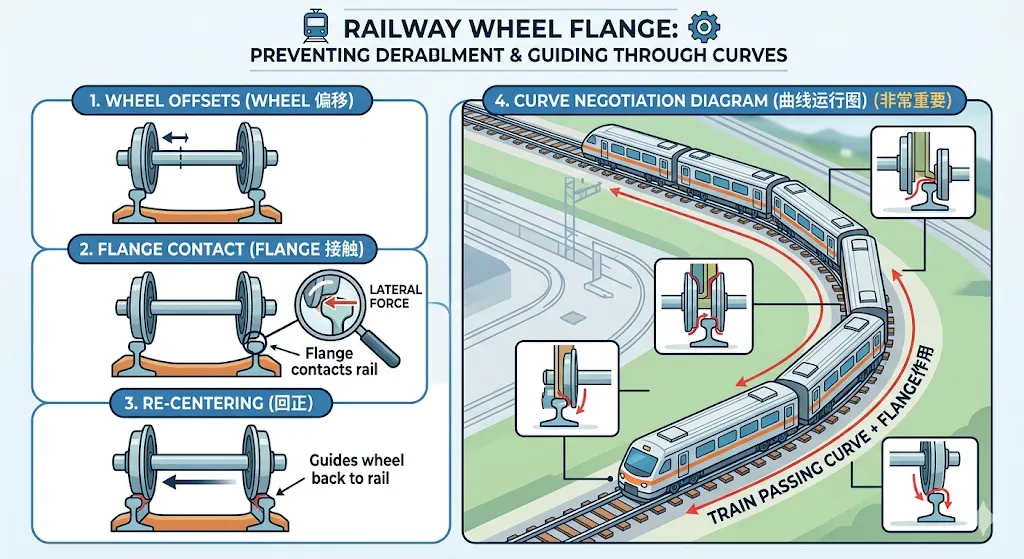
If the wheel starts moving sideways, the flange will:
So instead of the wheel “falling off” the track, the flange acts like a physical safety boundary.
This is the main reason why railway wheels have flanges in almost all rail systems in the world.
Railways are not straight lines. They include many curves, interruptores, and junctions.
When a train enters a curve, the wheelset experiences strong lateral forces.
In this situation, the flange helps by:
No entanto, the flange is not constantly pushing against the rail. It only becomes active when needed.
This is why railway engineers describe it as a “guidance safety feature” rather than a driving contact surface.
To understand the flange properly, we need to look at how a wheel actually runs on a rail.
In normal conditions:
These conditions include:
So in reality, a railway wheel is designed for rolling contact on the tread, not continuous flange contact.
This is a key point many people misunderstand.
Railway tracks are not perfect. Ao longo do tempo, even well-maintained rail systems may have:
O rail wheel flange design provides a built-in safety margin.
Even when conditions are not ideal, the flange ensures:
This is especially important in heavy freight and industrial rail systems.
A common question is:
👉 “If one flange is good, wouldn’t two be safer?”
The answer is no — not for railway systems.
If both sides had flanges:
É por isso que as ferrovias padrão usam um projeto de flange único.
No entanto, existem rodas de flange dupla - mas principalmente em sistemas industriais (explicaremos isso mais tarde).
O projeto das rodas ferroviárias é na verdade um equilíbrio entre:
O flange é cuidadosamente projetado para que:
Este equilíbrio é o que torna os sistemas ferroviários modernos eficientes e confiáveis.
Sem flange, a roda perderia seu sistema de orientação lateral.
Isto poderia levar a:
Resumidamente, rail transport would become unreliable and unsafe.
That’s why the wheel flange is considered an essential safety component, not an optional feature.
Most railway systems use single flange wheels, but industrial applications sometimes use rodas de flange dupla.
We explain this in detail in another article:
But here is the simple difference:
In industrial environments, double flanges help provide extra lateral stability because:
O projeto de flange de roda ferroviária é amplamente utilizado em muitas indústrias, como:
Não importa a aplicação, o propósito é sempre o mesmo:
👉 seguro, estável, movimento guiado sobre trilhos
Em operação real, o flange pode desgastar-se gradualmente devido ao contato ocasional com os trilhos.
As causas comuns incluem:
É por isso que os operadores ferroviários inspecionam regularmente:
A manutenção adequada garante longa vida útil e operação segura.
Para usuários industriais, escolhendo o material certo (aço fundido ou forjado) também afeta significativamente a durabilidade do flange.
Então, por que as rodas ferroviárias têm flanges?
Because they provide a simple but powerful safety mechanism that keeps trains guided on the track under all real-world conditions.
The flange is not always working, but when it is needed, it plays a critical role in:
Sem isso, modern rail transport would not be as reliable, eficiente, or safe as it is today.
Because the rail itself already provides lateral guidance on the outer side. The inner flange is enough to keep the wheel aligned and prevent derailment while still allowing smooth movement on curves.
Não, they don’t. In normal operation, only the wheel tread is in contact with the rail. The flange only touches the rail during tight curves, lateral movement, or abnormal track conditions.
The main purpose is to guide the wheel along the rail, improve stability during operation, and prevent derailment when lateral forces occur.
Because they act as a mechanical safety barrier. Even if the wheel starts to move sideways due to load or track conditions, the flange helps keep the wheelset within the rail gauge.
Sem flange, the wheel would have no lateral guidance. This increases the risk of derailment, especially in curves or under heavy load conditions.
Em aplicações industriais como guindastes ou sistemas de manuseio de materiais, rodas de flange dupla são usadas para fornecer estabilidade extra porque as esteiras podem não estar perfeitamente alinhadas e as cargas geralmente são mais pesadas.
A banda de rodagem é a superfície principal que carrega a carga e rola no trilho. O flange é a borda guia interna que só engata quando ocorre movimento lateral.
Sim. Os flanges podem se desgastar com o tempo devido à negociação da curva, cargas pesadas, e condições da pista. É por isso que a inspeção e manutenção regulares são importantes nas operações ferroviárias.
No Luoyang Fonyo Indústrias Pesadas Co., Ltda., somos especializados na fabricação de alta qualidade rodas ferroviárias para aplicações industriais e pesadas.
Nossos produtos incluem:
Our wheels are widely used in railway systems, equipamento de mineração, usinas siderúrgicas, and industrial material handling systems.
Se você está procurando um fornecedor confiável de rodas ferroviárias, we are ready to support your project.
👉 Website: www.railwaypart.com
Estamos ansiosos para trabalhar com você.